
Having two health insurance policies, also known as dual health coverage, can provide additional financial protection and reduce out-of-pocket healthcare expenses. Weighing the pros and cons of having two health insurance policies is essential before making this decision, as it may offer broader coverage and lower medical costs but can also create complexities in claims processing and policy coordination. Understanding the advantages and disadvantages can help you determine whether maintaining two policies is the right choice.
What Does It Mean to Have Two Health Insurance Policies?
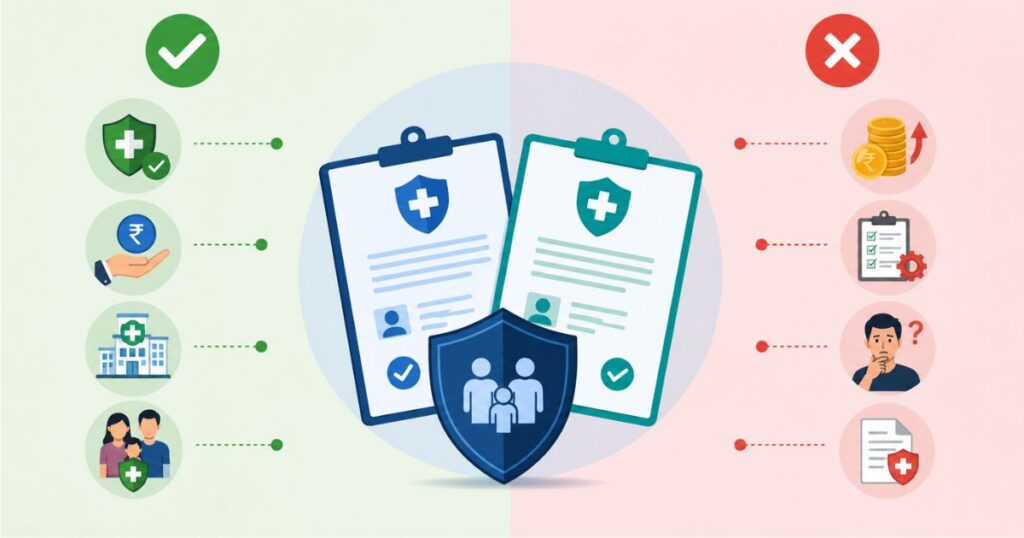
Dual health insurance coverage simply means you’re enrolled in two separate health plans at the same time. And yes it’s completely legal in the United States.
You don’t have to pick one or the other. Both plans stay active, and they work together to cover your medical bills.
Here are the most common ways people end up with two plans:
- Spouses on separate employer-sponsored plans, where each adds the other as a dependent
- Adults under 26 who stay on a parent’s plan while also having their own
- Medicare and private insurance combined, common for working seniors
- Medicaid and private insurance, often for lower-income families
- Children of divorced parents covered by both mom’s and dad’s plans
- Dual-job workers who qualify for benefits at two employers
One important catch: your two insurers won’t just split every bill 50/50. They follow a system called coordination of benefits to decide who pays what.
How Does Coordination of Benefits (COB) Work?
Coordination of benefits (COB) is a set of rules that stops you from collecting more than 100% of a medical bill across both plans. In plain terms, you can’t profit from being sick.
Here’s how it plays out, step by step:
- You receive care. You visit a doctor, get a test, or have a procedure.
- Your primary plan pays first. It processes the claim and covers its share based on its rules.
- The leftover balance goes to your secondary plan. Your primary insurer sends the remaining amount over.
- Your secondary plan reviews and pays. It covers what it can, based on its own rules and limits.
- You pay whatever’s left. Any remaining balance is your responsibility.
The big takeaway: even with two plans, you’ll never get paid more than your total bill. And your usual out-of-pocket costs copays, deductibles, and anything neither plan covers still apply.
Primary vs. Secondary Insurance: Who Pays First?

You don’t get to choose which plan is primary. State law and the terms written into each policy decide that for you.
The plan that pays first is your primary insurance. The other one, which picks up leftovers, is your secondary insurance. Here’s how it usually shakes out:
| Your situation | Primary plan | Secondary plan |
| Your job + your spouse’s job | Your own employer plan | Your spouse’s plan |
| Employer plan + Medicaid | Employer plan | Medicaid (almost always last) |
| Employer plan + Medicare (company with 20+ employees) | Employer plan | Medicare |
| Employer plan + Medicare (company under 20 employees) | Medicare | Employer plan |
| Your plan + parent’s plan (under 26) | Your own plan | Parent’s plan |
| Divorced parents’ plans for a child | Decided by the birthday rule | The other parent’s plan |
The birthday rule decides which parent’s plan is primary for a child covered by both. It’s not about who’s older—it’s about whose birthday lands earlier in the calendar year. So a parent born in March comes before a parent born in September, regardless of birth year.
What Are the Pros of Having Two Health Insurance Policies?
When dual coverage works, it really works. Here’s what you stand to gain:
- Lower out-of-pocket costs. Say your primary plan covers 80% of a $1,000 bill. That leaves $200. Your secondary plan may pick up some or all of that remaining chunk.
- Broader provider access. Two plans can mean two networks, giving you more doctors and hospitals to choose from.
- Coverage gap protection. One plan might skip mental health visits, fertility treatment, or a specific drug. The second plan can fill that hole.
- Continuity during transitions. Switching jobs or aging off a parent’s plan? A second policy keeps you covered during the gap.
- Stronger protection for heavy users. If you have a chronic condition or expect major care, two plans soften the financial blow.
What Are the Cons of Having Two Health Insurance Policies?

Now for the flip side. A second plan adds real costs and headaches:
- Higher combined premiums. You’re paying for two plans every single month, whether you use them or not.
- Two deductibles to satisfy. You may have to meet both before either plan pays much. That can wipe out your savings fast.
- More paperwork and confusion. Two insurers means twice the claims, statements, and phone calls to untangle errors.
- Higher chance of denied claims. ACA marketplace plans denied 19% of in-network claims in 2023, according to KFF. With two insurers reviewing your claims, there’s more room for rejection and delay.
- Redundant coverage. If both plans cover the same things, your second plan may add little real value.
- No free healthcare. Two plans don’t equal zero bills. Copays, deductibles, and exclusions still hit your wallet.
When Does Having Two Health Insurance Policies Actually Make Sense?
The honest answer: it depends on your situation. Let’s split it cleanly.
Dual coverage is often worth it if you:
- Have a chronic condition or expect high medical costs
- Need a bridge during a COBRA transition after losing a job
- Get one or both premiums heavily subsidized by an employer
- Have a specific need your main plan won’t cover
- Are on Medicare and want help with dental or vision gaps
Dual coverage usually isn’t worth it if you:
- Have two plans that cover basically the same things
- Rarely use medical care
- Already have one comprehensive, low-deductible plan
- Find the paperwork and premiums outweigh any savings
The HSA & HDHP Trap Nobody Warns You About
Here’s a costly mistake that catches people off guard. If you have a high-deductible health plan (HDHP) paired with a health savings account (HSA), adding a second plan can disqualify you from contributing to that HSA.
How? IRS rules say you can only contribute to an HSA if your only coverage is HDHP coverage. If your second plan is a regular, non-HDHP plan that pays for care before you hit your deductible, the IRS no longer considers you HSA-eligible.
That means you could lose your tax-free HSA contributions—a benefit worth thousands a year for some families.
Good to know: If both you and your spouse have separate HDHPs, you can usually keep your HSA eligibility. The problem comes from layering a low-deductible plan on top of your HDHP.
Before you add a second plan, talk to a tax professional. The HSA hit can quietly cancel out any savings the extra coverage promised.
Non-Duplication of Benefits Clauses
This one is sneaky. Some secondary plans include a non-duplication of benefits clause, which can mean your second plan pays nothing at all.
Here’s how it works. Normally, your secondary plan covers part of what your primary leaves behind. But with a non-duplication clause, the secondary plan only pays if its normal payment would have been higher than what the primary already paid.
A quick example:
- Both plans cover 80% of a $1,000 bill.
- Your primary plan pays $800.
- Your secondary plan would also have paid $800.
- Since the primary already paid that much, your secondary plan pays $0.
You’re left owing the same $200 you’d owe with just one plan while still paying for two. Always read the fine print before assuming a second policy adds value.
Does Having Two Health Insurance Policies Save Money?
Time to do the math. The only way to know if dual coverage pays off is to compare the real cost against the real savings.
Start with what you’ll spend:
- Add up both premiums. Multiply each monthly premium by 12.
- Add both deductibles. Factor in what you’d pay before each plan kicks in.
- Compare to your realistic yearly usage. Look at last year’s medical bills as a guide.
Then ask: do the savings from the second plan beat its added cost? If your combined premiums and deductibles cost more than the second plan saves you, dual coverage isn’t efficient.
One more wrinkle: employer premiums are often taken out pre-tax, which softens the cost. Premiums you pay yourself are usually after-tax, and you can only deduct medical costs that pass a high IRS threshold. That makes a second individual plan even harder to justify on price alone.
Expert Insight: What an Insurance Professional Wishes Patients Knew
Benefits brokers see the same mistake over and over: people sign up for a second plan expecting big savings, then get blindsided by the paperwork.
“The most common dual-coverage mistake I see is people assuming two plans automatically means smaller bills. They forget about coordination of benefits and two deductibles. By the time they realize the second plan barely helps, they’ve already paid months of extra premiums.” Benefits broker perspective
The pattern is clear. People tend to overestimate the savings and underestimate the COB paperwork. A second plan only pays off when you’ve checked how the two policies coordinate not just how much each one covers on paper.
If you’re seriously weighing dual coverage, ask both insurers exactly how they’d coordinate your claims before you enroll.
Is It Legal to Have Two Health Insurance Policies in the United States?

Yes. It’s perfectly legal to carry two health insurance policies in the U.S. Millions of people do it every year.
That said, you have a few legal responsibilities:
- Disclose your dual coverage to both insurers so they can coordinate benefits.
- Designate primary and secondary correctly, following each plan’s rules.
- Never double-bill or try to collect more than 100% of a medical cost.
Trying to game the system even by accident can count as insurance fraud. Honesty keeps you on the right side of the law and helps your claims process smoothly.
Making the Right Call on Dual Coverage
Choosing whether to keep two health insurance policies comes down to three simple questions:
- How often do you use medical care?
- Does your current plan leave real gaps?
- Do the savings beat the added premiums and hassle?
If you’re a high-need patient or part of a large family, a second plan can genuinely protect you. If you’re healthy with one comprehensive plan, it’s probably just extra cost and paperwork.
Your next steps:
- Run the annual cost comparison using the math above.
- Call both insurers and ask exactly how they’d coordinate benefits.
- Consult a fee-only broker who has no stake in selling you a plan.
A little homework now can save you a lot of money and frustration later.
Conclusion
Two health insurance policies can offer valuable benefits, including increased coverage and reduced personal healthcare expenses. However, managing multiple policies may involve higher premiums and more complicated claims procedures. Carefully reviewing both plans can help you maximize benefits while avoiding unnecessary costs.
FAQs
Can you have two health insurance policies at the same time in the U.S.?
Yes, it’s completely legal to have two health insurance policies at once in the United States. About 43 million people did so in 2021. Both plans stay active and work together through coordination of benefits to cover your medical bills.
How does coordination of benefits work with two plans?
Coordination of benefits is a set of rules that decides which plan pays first. Your primary plan pays its share, then sends the remaining balance to your secondary plan. Together, the two plans can’t pay more than 100% of your total bill.
Do you have to pay two deductibles with two health insurance policies?
Often, yes. Each plan typically has its own deductible, and you may need to meet both before either pays much. This is one reason dual coverage doesn’t always save money, especially if you rarely use medical care.
What determines which policy is primary and which is secondary?
State law and your policy terms decide not your preference. Your own employer plan is usually primary over a spouse’s or parent’s plan. For children of divorced parents, the birthday rule applies, using whichever parent’s birthday falls earlier in the year.
Can two policies pay you more than your medical bills?
No. Coordination of benefits caps total payments at 100% of your bill. You can’t profit from having two plans. At best, your combined coverage reduces or eliminates your out-of-pocket costs for a covered service.