
Behavioral & Mental Health Billing Services help therapists, psychologists, psychiatrists, and counseling practices streamline their revenue cycle management. Professional Behavioral and Mental Health Billing Services ensure accurate claim submission, faster reimbursements, reduced denials, and compliance with healthcare regulations, allowing providers to focus on delivering quality patient care.
What Behavioral and Mental Health Billing Services Actually Cover

Let’s be clear about something upfront: a real behavioral health billing service isn’t just someone who submits your claims. The best ones run your entire revenue cycle from the moment a patient schedules an appointment to the day their final balance is collected.
Here’s what a comprehensive service covers:
Medical coding (CPT, ICD-10, and HCPCS) Every session you provide needs a code a precise numerical label that tells the insurance company exactly what service you delivered. Get it wrong and the claim gets denied. Get it right and you get paid. Certified coders who specialize in behavioral health know these codes inside out.
Claims scrubbing and submission Before a claim is sent to the payer, it goes through a scrubbing process essentially a quality check that catches errors before they become denials. The goal is a clean claim rate above 95%, meaning 95 out of 100 claims are accepted and paid on the first submission.
Denial management and accounts receivable follow-up Denials happen. What matters is what happens next. A strong billing service doesn’t just flag the denial it investigates the reason, fixes the problem, and resubmits with a proper appeal. Unworked denials are where most practices hemorrhage money.
Insurance eligibility verification Before a patient walks through your door, their insurance needs to be verified. Does their plan cover behavioral health services? What’s their deductible? Do they need a referral? Catching these details upfront prevents a cascade of problems downstream.
Prior authorization management Many payers especially for intensive outpatient programs (IOP) or partial hospitalization programs (PHP) require pre-approval before services can be billed. Missing an authorization means the claim gets denied, full stop. A good billing service tracks every authorization requirement, so you never get caught off guard.
Provider credentialing and insurance enrollment Before you can bill a single payer, you need to be credentialed with them a process that typically takes 90 to 120 days and involves mountains of paperwork. Your billing partner should handle this so you can start getting paid faster and stay in-network without interruption.
Why Mental Health Billing Is Harder Than General Medical Billing

Here’s something most people outside the industry don’t realize: behavioral health billing is genuinely one of the most complex specialties in all of medical billing. It’s not harder because providers are disorganized. It’s harder because the system is built that way.
Consider what you’re dealing with:
The payer maze. Your patient has Aetna insurance. Simple, right? Not quite. For behavioral health claims, you often need to bill Aetna Behavioral Health a completely separate entity with different payer IDs, different fee schedules, and different rules. Submit to the wrong one and you’re starting over.
The Mental Health Parity and Addiction Equity Act (MHPAEA). Federal law requires that insurance companies cover mental health services at the same level as physical health services. In practice, payers find creative ways around this and fighting back requires documentation, appeals expertise, and knowledge of your legal rights.
Time-based billing rules. Therapy sessions are billed in time increments. A 45-minute session uses a different CPT code than a 60-minute session. If your documentation doesn’t clearly reflect the time spent, the payer can downcode your claim paying you less than you earned.
Telehealth modifiers that keep changing. Since the pandemic, telehealth billing for behavioral health has expanded significantly. But the rules around which modifiers to use (GT, 95, or others), which payers accept telehealth, and which place-of-service codes apply are updated constantly. One wrong modifier and the claim bounces.
Lower reimbursement rates. Research consistently shows that insurance companies reimburse behavioral health services at rates 20% to 30% lower than equivalent medical or surgical services even when parity laws say they shouldn’t. Catching underpayments requires comparing every payment against your contracted rates, something very few in-house billing teams have time to do.
Understanding why medical claims get denied in behavioral health requires specialty-specific expertise not a generic billing process.
The Behavioral Health Billing Process: Step by Step
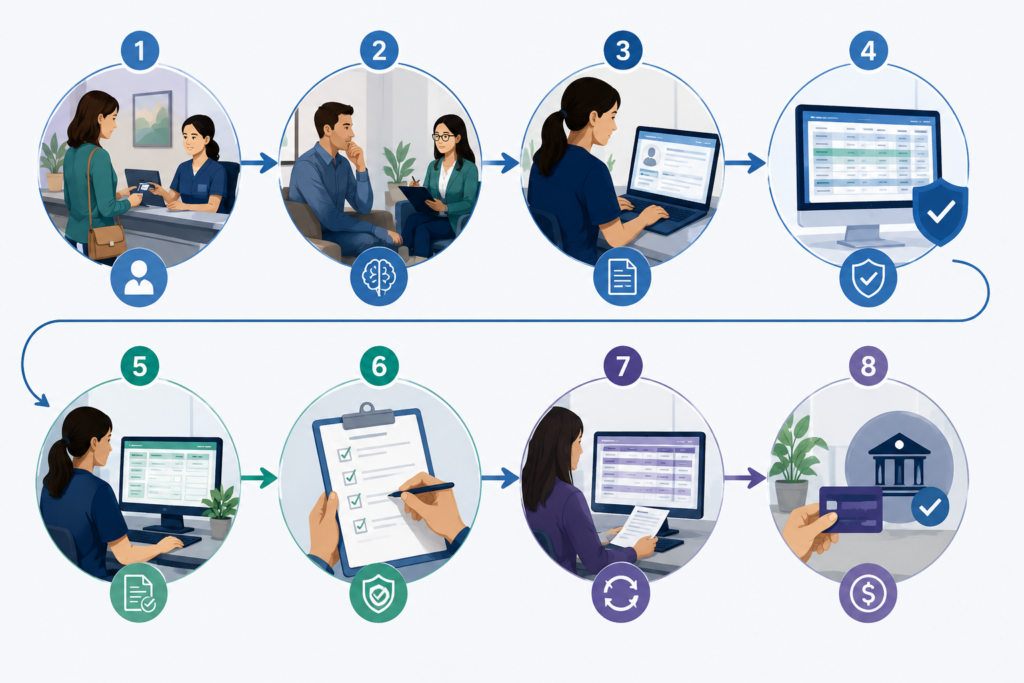
Understanding how the billing cycle works helps you spot where money is being lost. Here’s the complete journey from appointment to payment:
Step 1 Patient registration and insurance verification Before the first session, confirm the patient’s insurance is active, identify their mental health benefits specifically, check their deductible and copay, and flag any prior authorization requirements. This step alone prevents the majority of downstream denials.
Step 2 Prior authorization (when required) If the payer requires pre-approval common for IOPs, PHPs, psychiatric inpatient stays, and some outpatient services submit the authorization request with supporting clinical documentation. Track the approval, its expiration date, and the number of authorized sessions.
Step 3 Session documentation and medical necessity After every session, the provider documents what happened and why it was medically necessary. This documentation is the backbone of your claim. Vague or incomplete notes are one of the top reasons behavioral health claims get denied.
Step 4 CPT and ICD-10 code assignment A certified coder reviews the documentation and assigns the correct procedure code (CPT) and diagnosis code (ICD-10). For behavioral health, this means choosing the right therapy code based on session time, modality, and provider type then pairing it with the appropriate DSM-5-aligned diagnosis.
Step 5 Claim scrubbing and electronic submission The claim is checked for errors wrong payer ID, missing NPI, incorrect place-of-service code, modifier issues before being submitted electronically. Clean claims get processed faster. Scrubbing is what separates a 95% first-pass rate from a 70% one.
Step 6 Payment posting and ERA reconciliation When the payer responds, the payment (or denial) gets posted to the patient’s account. Electronic remittance advice (ERA) files show what was paid, what was adjusted, and what was denied. Every line item should be reconciled against your contracted rates because underpayments are real and more common than most providers realize.
Step 7 Denial appeal and A/R follow-up Denied claims don’t disappear they go into the appeals queue. Every denial has a reason code, and every reason code has a correct response. Timely, well-documented appeals recover revenue that would otherwise be written off. Accounts receivable older than 90 days should be reviewed daily by your billing team.
CPT Codes Every Behavioral Health Biller Needs to Know
If there’s one area where mental health billing diverges most sharply from general medical billing, it’s the CPT code set. These aren’t interchangeable the wrong code on a behavioral health claim is a guaranteed denial.
Here are the codes that matter most:
| CPT Code | Service | Typical Duration |
| 90791 | Psychiatric diagnostic evaluation | 60+ min |
| 90792 | Psychiatric evaluation with medical services | 60+ min |
| 90832 | Individual psychotherapy | 16–37 min |
| 90834 | Individual psychotherapy | 38–52 min |
| 90837 | Individual psychotherapy | 53+ min |
| 90853 | Group psychotherapy | Per session |
| 90847 | Family therapy with patient present | Per session |
| 99484 | General behavioral health integration | Monthly |
And then there are the modifiers the add-on codes that change how a claim is interpreted:
- Modifier 95 telehealth services delivered via real-time audio-visual technology
- Modifier GT interactive telecommunications (used by some Medicare payers)
- Modifier 25 significant, separate evaluation and management on the same day as a procedure
- Modifier 59 distinct procedural service (prevents bundling denials)
The 2026 update you can’t ignore: CMS introduced crisis support codes G0560 and G0544 as part of the CY 2026 Physician Fee Schedule the most significant change to behavioral health billing codes in over a decade. If your practice provides crisis intervention services and you’re not yet billing these codes, you’re leaving reimbursement on the table.
2026 CMS Changes Every Mental Health Biller Must Know About

The CY 2026 Physician Fee Schedule Final Rule didn’t just tweak the margins. It reshaped how behavioral health services are billed, reimbursed, and reported across the board.
Here’s what changed and what it means for your practice:
New crisis support codes (G0560 and G0544). These codes reimburse providers for crisis intervention services delivered by behavioral health professionals. If your practice sees patients in acute mental health crises and most do these codes open a new, legitimate reimbursement pathway that didn’t exist before.
Collaborative Care Model (CoCM) billing updates. The CoCM is a team-based approach where a primary care provider, a behavioral health care manager, and a consulting psychiatrist work together. CMS has updated the billing requirements and reimbursement rates for this model. If you’re part of a CoCM arrangement, your billing codes and documentation protocols need to reflect the new rules.
Behavioral Health Integration (BHI) code changes. Code 99484 and the broader BHI code family were updated to reflect new care coordination requirements. Monthly billing under these codes now requires more specific documentation of care manager activities.
What this means practically: If your billing team or billing service isn’t actively tracking CMS updates, you may be using outdated codes or missing new reimbursement opportunities entirely. The 2026 changes are a compliance issue, but they’re also a revenue issue.
Compliance in Behavioral Health Billing: What You Can’t Afford to Ignore
Behavioral health billing doesn’t just have to be accurate. It has to be legal. The compliance framework governing this space is more complex than most specialties and the penalties for getting it wrong range from claim recoupment to federal investigation.
The four frameworks you need to understand:
HIPAA (Health Insurance Portability and Accountability Act) Every piece of patient data involved in the billing process demographic information, diagnosis codes, treatment records is protected health information (PHI). Your billing service must be fully HIPAA-compliant, with documented security protocols and business associate agreements (BAAs) in place.
The Mental Health Parity and Addiction Equity Act (MHPAEA) This federal law prohibits insurance companies from imposing more restrictive limitations on mental health and substance use disorder benefits than they apply to medical and surgical benefits. When a payer denies your claims citing “not medically necessary” at rates that wouldn’t apply to a physical health claim, that’s potentially a parity violation and you have the right to challenge it.
42 CFR Part 2 If your practice provides substance use disorder treatment, you operate under a stricter confidentiality framework than standard HIPAA. Patient records related to SUD diagnosis or treatment cannot be disclosed without explicit written consent even to other treating providers without specific authorization. Billing for SUD services requires careful handling to avoid inadvertent disclosure.
The False Claims Act Billing for services not rendered, upcoding (billing a higher-level service than was provided), and unbundling (splitting a single service into multiple billable components) are federal crimes under the False Claims Act. The penalties include fines of up to $23,000 per false claim, plus treble damages. Good documentation isn’t just good practice it’s your legal defense.
Expert Insight: The 6 Billing Mistakes Costing Mental Health Practices the Most Revenue
After reviewing thousands of behavioral health claims across dozens of practice types, the same patterns appear again and again. These are the six mistakes that consistently drain revenue and they’re all preventable.
Mistake 1 Billing to the wrong payer entity. Your patient has United Healthcare. But their behavioral health benefits are administered by Optum. Submit to United and the claim bounces. This happens constantly, and the fix is simple: verify the behavioral health payer separately from the medical payer during eligibility checks.
Mistake 2 Missing or incorrect modifiers on telehealth claims. Telehealth has become a cornerstone of behavioral health care. But billing it correctly requires the right modifier (95 vs. GT), the right place-of-service code (02 for telehealth, 10 for patient’s home), and the right documentation. One wrong element and the claim is denied or worse, flagged for audit.
Mistake 3 Skipping eligibility verification before the session. “Their insurance card looked fine.” That’s not eligibility verification. A patient’s coverage can terminate overnight. Their deductible can reset. Their behavioral health benefits can be carved out to a different payer. Verifying benefits before every single session is non-negotiable.
Mistake 4 Underdocumenting medical necessity. Insurance companies don’t pay for therapy because the patient wants it. They pay because the patient needs it and your documentation has to make that case explicitly. Notes that read “patient reports improvement, will continue therapy” won’t survive a medical necessity review. Notes that document symptoms, functional impairment, treatment goals, and clinical rationale will.
Mistake 5 Submitting claims past payer deadlines. Most payers require claims within 90 to 365 days of the date of service. Miss the window and the claim is dead there’s no appeal process for timely filing denials. A billing service with robust claim tracking prevents this entirely.
Mistake 6 Ignoring underpayments. This one is insidious. The claim gets paid just not at the contracted rate. Without a system that compares every payment against your fee schedule, underpayments get posted and forgotten. Over a year, these small shortfalls add up to thousands of dollars of revenue that was owed to you and never collected.
Which Mental Health Providers Need Specialized Billing Services?

The short answer: all of them. But the type of billing complexity varies significantly by practice type.
Solo therapists and LCSWs face the most acute administrative burden relative to their size. They’re often billing EAP (Employee Assistance Program) plans alongside commercial insurance, dealing with out-of-network superbills, and managing everything without a dedicated billing staff member. Outsourcing is almost always the financially smarter choice.
Psychiatrists deal with the unique challenge of medication management codes layered alongside psychotherapy codes and documentation requirements that must clearly distinguish between the two. Billing 99213 alongside 90833 (add-on psychotherapy) requires precise documentation of separate, distinct services.
Group practices face credentialing complexity at scale every provider needs to be separately credentialed with every payer, and incident-to billing rules add another layer of compliance risk when non-physician practitioners see patients under physician supervision.
IOP and addiction treatment centers operate under the strictest billing environment of all combining SUD-specific codes, 42 CFR Part 2 compliance, daily authorization tracking, and HCPCS Level II coding requirements. A generalist billing company almost always underperforms in this setting.
Telehealth-only practices have emerged as a distinct billing category since 2020. Their claims require consistent application of telehealth modifiers, place-of-service codes, and state-specific licensure requirements all of which change frequently.
What Results Should You Expect From a Behavioral Health Billing Service?
Numbers matter. Before you hand over your revenue cycle to any company, you should know exactly what good performance looks like and hold them to it.
| KPI | Industry Average | What Top Services Achieve |
| Clean claim rate | 75–85% | 95%+ |
| A/R days | 45–60 days | 25–30 days |
| Denial rate | 15–25% | Under 5% |
| Collection ratio | 70–80% | 95–98% |
| Claim turnaround | 5–7 days | 24–48 hours |
If a billing company can’t tell you their average clean claim rate and denial rate for behavioral health clients specifically that’s a red flag. These are the metrics that determine whether your practice is financially healthy or slowly bleeding out.
Conclusion
Professional behavioral and mental health billing services enable providers to focus on patient care while ensuring efficient claim processing and maximum revenue collection. Outsourcing billing can improve cash flow, reduce administrative burdens, and maintain compliance with industry regulations.
FAQs
What is the difference between behavioral health billing and regular medical billing?
Behavioral health billing uses a distinct set of CPT codes, operates under specific compliance laws like MHPAEA and 42 CFR Part 2, and involves payer structures where behavioral health benefits are often carved out to separate entities. The documentation requirements, authorization rules, and reimbursement rates are all different from general medical billing which is why specialty-specific expertise matters.
How much do behavioral and mental health billing services cost?
Most billing services charge a percentage of collections, typically between 4% and 10% depending on practice size, claim volume, and service scope. That fee generally covers the full revenue cycle coding, submission, denial management, patient statements, and reporting. There are no upfront setup fees with reputable providers, and you only pay when you get paid.
Why do mental health claims get denied so often?
The most common reasons include incorrect CPT codes, missing or expired prior authorizations, billing to the wrong payer entity, inadequate medical necessity documentation, and late claim submission. Behavioral health claims are denied at higher rates than most medical specialties precisely because the billing rules are more complex and payer scrutiny is higher.
How long does mental health provider credentialing take?
The credentialing process typically takes 90 to 120 days per payer, depending on how responsive the payer’s credentialing department is and how complete your documentation is. A billing service that manages credentialing proactively gathering documents early, submitting applications the moment a slot opens, and following up consistently can shave weeks off that timeline.
What is incident-to billing in mental health?
Incident-to billing allows a non-physician practitioner (such as an LPC or LMFT) to bill under a supervising physician’s NPI and receive the full physician reimbursement rate rather than the reduced rate typically applied to non-physician practitioners. The rules are strict: the supervising physician must conduct the initial evaluation, establish the treatment plan, and maintain active involvement in the patient’s care. Medicare audits this closely.
Should I outsource my mental health billing or keep it in-house?
For most practices, outsourcing delivers better financial results at a lower total cost than maintaining in-house billing staff especially once you factor in salary, benefits, training, software, and the ongoing cost of billing errors. The exception is large health systems with dedicated revenue cycle departments. If you’re a solo practitioner or a group practice under 20 providers, outsourcing almost always wins on both cost and performance metrics.
What are the new behavioral health billing codes for 2026?
The most significant additions are crisis support codes G0560 and G0544, introduced in the CY 2026 Physician Fee Schedule Final Rule. CMS also updated the Collaborative Care Model billing requirements and Behavioral Health Integration codes. If you haven’t reviewed your billing code set against the 2026 fee schedule, now is the time.