
Emergency room billing can be confusing because multiple services, providers, and medical procedures may be included in a single visit. Charges typically depend on the severity of the condition, diagnostic tests performed, treatments provided, and whether the hospital and physicians are in-network with your insurance plan. Understanding how emergency room billing works can help patients better manage healthcare costs and avoid unexpected medical bills.
What Is Emergency Room Billing?

Emergency room billing is how hospitals and ER physicians charge for the care you receive during an emergency visit. It isn’t one bill, it’s a bundle of separate claims covering the facility, the physician, and sometimes outside specialists like radiologists or anesthesiologists.
Each of these parties bills independently, which is the single biggest reason ER bills feel so chaotic compared to, say, a bill from your family doctor.
The ER Billing Process, Step by Step
Here’s what actually happens between the moment you check in and the moment you’ve paid off your balance.
- You receive care. A nurse triages you, a physician evaluates and treats you, and any tests (labs, imaging) or procedures happen during the visit.
- Your visit gets coded. Medical coders translate everything that happens in the exam, tests, treatments into standardized billing codes (CPT codes) and assign a severity level from 1 to 5, with Level 5 being the most critical.
- Claims go out. Your insurer typically receives two separate claims: one from the facility, one from the physician group. If you needed radiology, pathology, or anesthesia from an outside group, those bills separately too.
- Your insurer reviews and pays. The insurer checks the claims against your plan, applies your deductible, copay, and coinsurance, and pays its share.
- You get an EOB. Your insurance company mails or emails an Explanation of Benefits showing what was billed, what insurance paid, and what you’re expected to owe. This is not a bill yet.
- You get a bill. Two to four weeks after the EOB, the facility and/or physician group sends you a statement for whatever balance remains.
Format note: This sequence is the backbone of nearly every patient confusion point below, so it’s worth re-reading once before moving on.
Why Did I Get More Than One Bill From the ER?
Because an ER visit involves multiple billing entities that are often separate legal businesses operating inside the same building. The hospital doesn’t employ the radiologist who read your CT scan, and it often doesn’t employ the ER physician group either.
| Who Bills You | What It Covers | Common Surprise |
| Facility (hospital or freestanding ER) | Room, equipment, nursing, overhead, supplies | Often the largest single line item |
| ER physician group | The doctor’s evaluation and treatment decisions | May be a separate practice, sometimes out-of-network |
| Radiology | Reading X-rays, CT scans, ultrasounds | Frequently a third-party contractor billing separately |
| Pathology/Lab | Bloodwork, cultures, biopsy analysis | Often bills weeks after your visit |
| Anesthesia (rare in ER, common if admitted) | Sedation for procedures | Usually a separate contracted group |
Some standalone ER chains, like Exceptional Emergency Center, fold imaging and lab charges into a single facility bill rather than billing them separately but the physician claim almost always still arrives on its own.
Larger hospital systems often go the other direction and name their third-party billers explicitly separate companies handling anesthesia, radiology readings, pathology, and even ambulance transport, each with their own payment portal and phone number. If you’re tracking down a confusing charge, ask the main hospital billing office for a full list of every entity that billed for your visit; they’re required to be able to tell you, even if each one sends its own statement.
Understanding the Place of Service code on each claim helps identify which entity billed for which portion of care and whether the correct facility or professional code was applied.
Is an EOB a Bill?
No. An Explanation of Benefits (EOB) is not a bill, it’s a summary your insurance company sends after processing a claim, showing what was charged, what insurance paid, and what you might owe. The actual bill comes later, directly from the provider, and may be lower than the EOB suggested if in-network adjustments apply.
| EOB | Bill | |
| Who sends it | Your insurance company | The hospital or physician group |
| When it arrives | First, usually within a few weeks of your visit | Second, typically 2–4 weeks after the EOB |
| Is payment required? | No | Yes |
| What it shows | Charges, insurance payment, your estimated responsibility | The actual amount due and how to pay it |
If you only ever see an EOB and no bill follows, that can simply mean insurance covered the visit in full.
What Is a Facility Fee and Why Is It So High?

A facility fee is the charge for being seen at an emergency department the cost of walking through the door separate from whatever specific care you receive. It covers 24/7 staffing, equipment, and the overhead of keeping an ER ready for anything, and it’s billed regardless of how minor your visit turns out to be.
It’s also the biggest driver of the rising cost of ER care. According to a Peterson-KFF Health System Tracker analysis, the average emergency department visit cost $2,453 in total, with enrollees paying $646 out-of-pocket on average. Facility fees account for roughly 80% of the total cost of a typical ER visit, and facility fee claims have grown faster than professional fees, even as professional fees themselves rose 132% between 2004 and 2021.
Your facility fee is set by severity level, determined by your symptoms, the physician’s clinical decisions, and what testing was needed not by how the visit felt to you. A panic attack that turns out to be nothing dangerous can still generate a high-severity facility fee if extensive testing was medically necessary to rule out something serious.
Freestanding (standalone) ERs tend to charge higher facility fees than hospital-based ERs for comparable visits, a pattern documented across multiple cost-transparency analyses because they don’t share overhead across other hospital departments.
Three things push a facility fee higher than you might expect:
- Severity coding. A Level 4 or 5 visit (high complexity or critical) carries a facility fee multiple times higher than a Level 1 (minor) visit, even if the time you spent in the ER felt similar.
- Time of day and staffing. Overnight, weekend, and holiday visits often carry higher facility charges because of premium staffing costs.
- Facility type. Large urban trauma centers and academic medical centers typically charge more than smaller community hospitals for the same severity level, reflecting their higher overhead and specialist availability.
None of these factors are things you control in the moment which is exactly why the protections below exist. For a deeper look at how facility-based billing differs from physician billing in outpatient settings, read our guide on ASC medical billing which explains the distinct fee structures that apply to ambulatory surgical centers versus hospital-based facilities.
Your Legal Protections: The No Surprises Act
The No Surprises Act is a federal law, effective since January 2022, that protects you from out-of-network bills for emergency care even if the ER or the doctor who treats you isn’t in your insurance network. You’re only responsible for your normal in-network copay, deductible, and coinsurance, no matter the facility’s network status.
Here’s what it actually guarantees:
- Insurers must treat emergency care as in-network, regardless of where you went.
- You cannot be balance-billed for the difference between what your insurer pays and what the provider charged.
- If a provider and insurer disagree on payment, they negotiate and if that fails, they enter a federal Independent Dispute Resolution (IDR) process rather than billing you the difference.
- The law also covers ground ambulance transport in emergencies, though air ambulance protections are narrower and vary by state.
What changed in 2026: Regulators released a Federal IDR Operations Final Rule in May 2026, aimed at clearing the massive backlog in dispute cases; the federal IDR process has received over 5 million disputes since 2022, far beyond the roughly 17,000 a year it was originally built to handle. The Departments of Health and Human Services, Labor, and Treasury also continue using enforcement discretion on how insurers calculate the Qualifying Payment Amount (QPA) , the benchmark rate used in payment disputes while related litigation (Texas Medical Association v. HHS) plays out. None of this changes your protection as a patient; it affects how providers and insurers settle disagreements behind the scenes.
There’s a second, older protection working alongside the No Surprises Act: EMTALA (the Emergency Medical Treatment and Labor Act), which requires any ER to screen and stabilize you regardless of your ability to pay or your insurance status. It’s why you’re never turned away though it doesn’t mean the care is free.
One gap worth knowing about: ambulances. The No Surprises Act covers ground ambulance balance billing for emergencies, but air ambulance protections are narrower, and coverage for the ground ambulance ride itself can still vary by state and by whether the service is run by a fire department, private company, or hospital system. If you’re billed separately for transport, that claim follows different rules than your ER facility and physician bills.
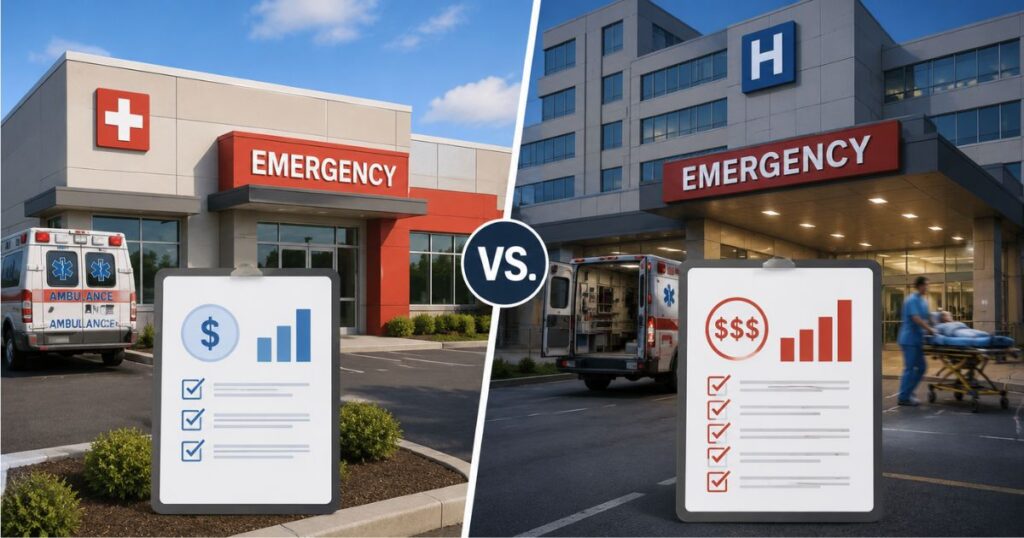
Standalone ER vs. Hospital ER: Billing Differences
| Hospital-Based ER | Standalone / Freestanding ER | |
| Facility fee size | Generally lower | Generally higher for comparable care |
| Number of separate bills | Often 2–4 (facility, physician, radiology, lab) | Sometimes fewer some bundle imaging/lab into the facility bill |
| Network status | Often in-network with major insurers | Frequently not contracted with any commercial insurer, though No Surprises Act protections still apply |
| Medicare/Medicaid acceptance | Usually accepted | Often not accepted, or accepted only at select locations |
| Best for | Anything requiring admission, surgery, or specialist follow-up on-site | Faster access in areas without a nearby hospital ER |
Both types are bound by EMTALA and the No Surprises Act. The difference is mainly in how high the facility fee runs and which insurance networks they’ve actually contracted with not in your legal billing protections.
What to Do If Your ER Bill Looks Wrong
Don’t pay anything until you’ve worked through this list.
- Request an itemized bill. Ask the billing office for a line-by-line breakdown, not just a summary total. Billing errors are common enough that this step alone can shrink a bill.
- Compare it against your EOB. Make sure the charges match what your insurer says was billed, and confirm your insurer applied your correct deductible, copay, and coinsurance.
- Check for balance billing. If you see a charge that looks like the gap between the provider’s full price and what insurance paid and you were treated for an emergency that may violate the No Surprises Act. Call your insurer’s help line or the No Surprises Help Desk to flag it.
- File an appeal if a claim was denied. Ask your insurer in writing why it was denied, and submit an appeal with supporting documentation from the ER (notes, test results) showing the visit met the prudent layperson standard meaning a reasonable person would have believed it was an emergency at the time, regardless of the final diagnosis.
- Ask about financial assistance before you ask about a payment plan. Most nonprofit hospitals are legally required to offer charity care programs, and many for-profit and standalone ERs offer self-pay or prompt-pay discounts even without a formal program. Ask specifically: “Do you have a financial assistance policy, and how do I apply?” Income thresholds for eligibility are often higher than people assume some programs cover patients earning up to 200–400% of the federal poverty line.
- Negotiate the cash-pay rate. If insurance doesn’t cover something or you’re uninsured, ask directly what the self-pay discount is. Many facilities reduce charges by 20–50% simply for asking before the bill goes to collections.
- Set up a payment plan as a last resort, not a first move. Once you’ve confirmed the bill is accurate, requested discounts, and ruled out financial assistance, a structured payment plan is reasonable but agreeing to one before checking the steps above can lock you into paying more than necessary.
For healthcare providers, this list of patient pain points is a direct map of where billing errors originate. Proactive denial management and accurate claims submission prevent most of these disputes before they reach the patient.
A Real ER Bill, Broken Down
Here’s what a fairly ordinary ER visit looks like once every line item lands, based on the kind of breakdown patients commonly report and the cost patterns documented by Peterson-KFF’s claims analysis:
- Facility fee (Level 3 severity): roughly $580–$900 the base charge for being evaluated
- Physician fee: a separate charge, often $300–$600, billed by a different entity than the hospital
- Bloodwork (CBC, BMP): billed by the lab, sometimes weeks later
- One X-ray or CT scan: billed separately by radiology, often the single biggest line item after the facility fee
- IV fluids and any medication given: smaller individual charges that add up fast
Add it up, and a visit that felt simple, say, abdominal pain that turned out to be nothing serious can easily cross $2,000–$2,800 in total charges before insurance adjustments, which lines up closely with the $2,453 average total cost KFF found across emergency department visits broadly. What you personally owe depends entirely on your deductible status and where you are in your plan year which is exactly why the EOB-then-bill sequence above matters so much.
Common Billing Terms Glossary
- Copay: A fixed dollar amount you owe for an ER visit, usually collected at check-in.
- Deductible: The amount you pay out-of-pocket each year before your insurance starts covering services.
- Coinsurance: A percentage of the remaining cost you owe after your deductible is met.
- Out-of-Pocket Maximum: The most you’ll pay in a plan year before insurance covers 100% of further costs.
- Balance Billing: Being charged the difference between a provider’s full price and what insurance paid is now largely illegal for emergency care under the No Surprises Act.
- Guarantor: The person legally responsible for paying a patient’s medical bill. In adult visits, this is usually the patient themselves. Learn more about the guarantor role in medical billing and when it shifts to a parent or guardian.
- Qualifying Payment Amount (QPA): The benchmark median in-network rate insurers use as a reference point in payment disputes.
Conclusion
Emergency room billing involves several factors that determine what you ultimately owe, including insurance coverage, co-pays, deductibles, and the level of care received. By reviewing your medical bills carefully and understanding the charges, you can identify errors, maximize insurance benefits, and make informed decisions about your healthcare expenses.
FAQ
Is an EOB the same as a bill?
No. An EOB comes from your insurance company and shows what was billed and what you might owe. The actual bill comes later from the provider directly, and is sometimes lower after in-network adjustments.
Can an ER bill me at out-of-network rates if I had no choice where to go?
No. Under the No Surprises Act, emergency care must be billed at in-network cost-sharing levels regardless of the facility’s network status with your pla
Why did I get separate bills from the hospital and the doctor?
Because the facility and the physician group are usually separate legal entities, even though you were treated in the same building during one visit. Radiology, pathology, and anesthesia groups often bill separately too.
What’s a facility fee, exactly?
It’s the base charge for being seen at an ER covering staffing, equipment, and 24/7 readiness separate from any specific tests or treatment you receive.
Can I negotiate my ER bill?
Yes. Requesting an itemized bill, asking about self-pay discounts, and applying for financial assistance can all reduce what you owe, especially if you’re uninsured or underinsured.
What should I do if my insurance denies my ER claim?
Request a written explanation from your insurer, then file an appeal with supporting documentation showing the visit met the prudent layperson standard for an emergency.