
POS 11 in medical billing refers to the “Office” Place of Service code used on healthcare claims. It indicates that medical services were provided in a physician’s office rather than in a hospital, clinic, or other healthcare facility. Accurate use of POS 11 is essential for proper claim processing, reimbursement, and compliance with insurance payer requirements.
What Is POS 11 in Medical Billing?
Let’s keep this simple.
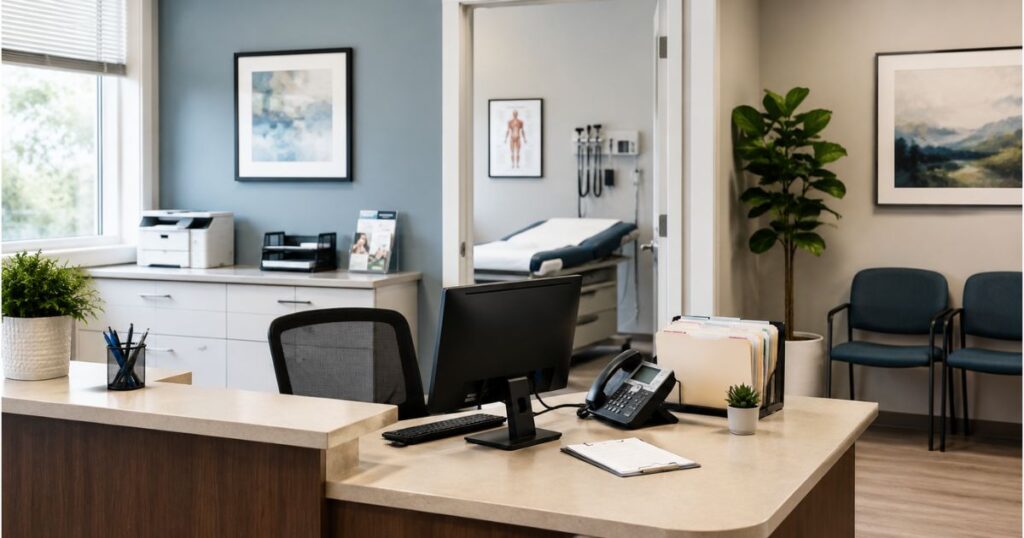
POS 11 means “Office.” It’s a two-digit code you stamp on a claim to tell the insurance company exactly where care happened. Not a hospital. Not a patient’s living room. An office that you own and run.
Think of it as a tiny address label for the payer. That label decides how your claim gets read and how much you get paid.
The Official CMS Definition, Unpacked
The Centers for Medicare & Medicaid Services (CMS) defines POS 11 in its Place of Service Code Set as a location where “health professionals routinely provide evaluation and management services” on an outpatient basis.
Three words in that definition do all the heavy lifting:
- Health professionals not just physicians. Nurse practitioners, PAs, and other licensed clinicians count too.
- Routinely this is your regular workplace, not a room you borrowed once.
- Ambulatory basis a fancy term for “the patient walks out the same day.” No overnight stay.
Miss any one of those, and POS 11 might be the wrong call.
What Services Fall Under POS 11?
If the care happens in your office and the patient heads home afterward, you’re usually in POS 11 territory. Here’s what that looks like in real life.
Routine and preventive visits:
- Annual wellness exams
- Sick visits and same-day appointments
- Specialist consultations cardiology, dermatology, you name it
Chronic care follow-ups:
- Diabetes and blood pressure check-ins
- Medication management visits
- Ongoing care for long-term conditions
Minor in-office procedures:
- Small skin biopsies or lesion removals
- Joint injections
- Basic gynecological or orthopedic procedures that don’t need a hospital
In-office diagnostics:
- EKGs and spirometry
- Basic imaging done during the visit
- Blood draws like CPT 36415, billed right there in your office
One quick gut check: if a hospital owns the room you’re standing in, this list doesn’t apply. More on that trap shortly.
Your POS 11 Setup: Build the System Before You Bill

Most guides explain the code. Few show you how to actually run it. Here’s the operational part the stuff that separates clean claims from chaos.
1. Build a location matrix.
Map every physical site you operate to one and only one place of service code inside your practice management system. Independent offices get POS 11. Hospital-owned spaces get a facility code. Lock it down so the front desk can’t switch it on a whim.
This single move prevents POS drift the slow, silent creep where the same visit gets coded differently depending on who’s at the keyboard. Strong Revenue Cycle Management systems build these rules into every workflow so POS errors never reach the payer.
2. Write billing SOPs your whole team follows.
Document who decides the place of service, how they decide it, and when. Your billing SOPs should leave zero room for guesswork. When five coders all reach the same answer, you’ve won half the battle.
3. Set claim scrubbing rules.
Turn on pre-submission edits that flag a POS 11 mismatch before the claim leaves your office. Claim scrubbing is your last line of defense it catches the error while it’s still cheap to fix.
Do these three things, and POS 11 in medical billing stops being a daily judgment call and becomes a system that runs itself.
How Does POS 11 Affect Reimbursement?
This is where the code stops being paperwork and starts being money.
Payers including Medicare pay you differently based on where care happened. They split the world into two buckets: the non-facility rate and the facility rate.
- Non-facility rate (POS 11): You cover the rent, staff, equipment, and supplies, so the fee schedule pays you more. You carry the overhead, you earn the premium.
- Facility rate (POS 22, POS 21): The hospital bills a separate facility fee for the overhead, so your professional payment drops.
That’s the fee schedule impact in a nutshell. Same work, different setting, different paycheck.
The CPT 99214 Dollar Walkthrough
Let’s put real numbers on it. Take a level 4 office visit CPT 99214.
- POS 11 (Office): roughly $135
- POS 22 (Outpatient Hospital): roughly $105
That’s a $30 gap per visit. Feels small. It isn’t.
- See 20 patients a day, and that’s $600 a day on the line.
- Run a 5-day week, and you’re looking at $3,000 a week.
- Scale it across a year, and the difference climbs past $150,000.
Code those visits wrong, and you hand that money back. This is why getting POS 11 right isn’t clerical it’s financial strategy.
Why Do POS 11 Claims Get Denied?
Most denials trace back to four mistakes. Here’s each one what happens, why it stings, and how to fix it.
1. Coding hospital-owned clinics as POS 11.
- What happens: A clinic looks and feels like an office, so staff default to POS 11.
- Why it costs you: If the hospital owns it as a provider-based department, the payer expects POS 22 or POS 19. You face overpayments and recoupment demands.
- The fix: Verify legal ownership before assigning the code. Always.
2. Billing the non-facility rate without documentation.
- What happens: You claim the higher office rate, but the file doesn’t back it up.
- Why it costs you: An audit finds the overhead was actually covered by an institution. The payer claws the money back.
- The fix: Keep documentation that proves your office independence space, staff, supplies.
3. POS drift across multi-site practices.
- What happens: A provider works two locations and uses the same code for both.
- Why it costs you: One site is independent, the other hospital-owned. The mismatch triggers claim denials and audit flags.
- The fix: Default each location in your system. Audit monthly.
4. Mixing telehealth rules into office claims.
- What happens: A virtual visit gets stamped POS 11 out of habit.
- Why it costs you: Most payers now want a telehealth code. The claim bounces.
- The fix: Separate your telehealth workflow entirely which brings us to the next section.
POS 11 vs Telehealth Codes: POS 02 and POS 10
Telehealth is where good billers get tripped up. The rules shifted, and not everyone kept pace.
During the public health emergency (PHE), payers temporarily allowed POS 11 with modifier 95 for video visits when the provider sat in their office. Those flexibilities reshaped everything and then started winding down.
Here’s where things stand:
| Scenario | Code to use |
| In-person office visit | POS 11 |
| Office-based telehealth (provider in office) | POS 11 + modifier 95 (Medicare, through current flexibilities) |
| Telehealth, patient not at home | POS 02 |
| Telehealth, patient at home | POS 10 |
Medicare vs Commercial Payer Rules
This is the part that bites.
- Medicare still lets office-based telehealth ride on POS 11 with modifier 95 while temporary flexibilities last as long as the billing provider is physically in the office.
- Commercial payers mostly moved on. Many now require POS 02 or POS 10 for virtual visits, full stop.
The safe play? Set your practice management system to default telehealth to POS 02 or 10, and override only when a payer confirms in writing that POS 11 is allowed. Check each payer’s current telehealth guide they don’t all agree.
POS 11 vs POS 22 vs POS 19 vs POS 21
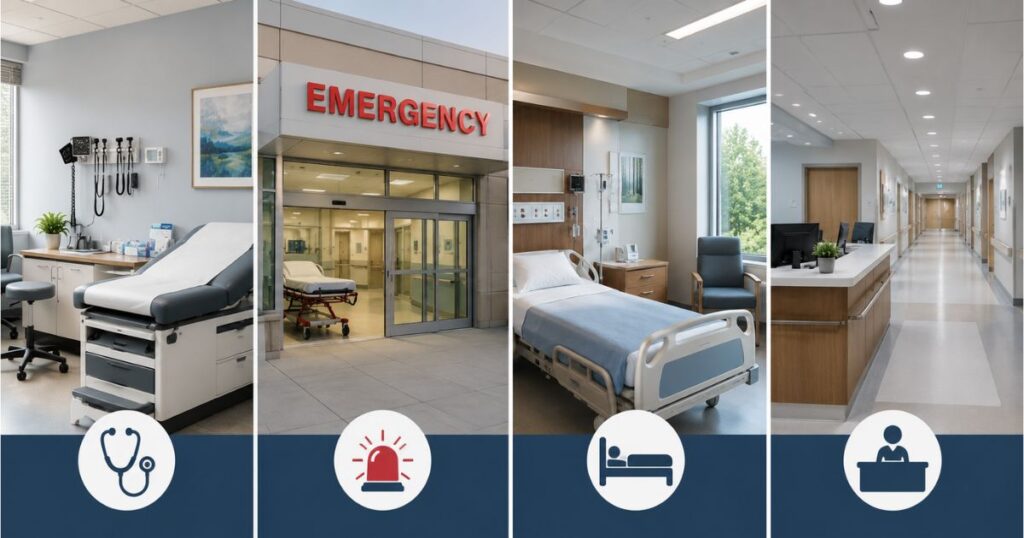
On paper, these codes can describe similar visits. To payers and auditors, they’re worlds apart. Here’s the full picture.
| Feature | POS 11 | POS 22 | POS 19 | POS 21 |
| Ownership | Independent practice | Hospital-owned | Hospital-owned | Hospital |
| Location | Anywhere (non-hospital) | On hospital campus | Off hospital campus | Inpatient hospital |
| Reimbursement rate | Non-facility (higher) | Facility (lower) | Facility (lower) | Inpatient rules |
| Billing structure | One professional claim | Split billing (pro + facility) | Split billing | Bundled inpatient |
| Audit risk if misused | High | Medium | Medium | High |
On-Campus vs Off-Campus: The Provider-Based Department Rule
Here’s the nuance most guides skip.
When a hospital owns a clinic, the address matters. On the main campus, it’s POS 22. Off-campus, it’s POS 19. Both are provider-based departments, meaning the hospital files a separate facility claim while you bill the professional component.
Medicare tracks POS 19 separately from POS 22 for transparency. So even if two hospital clinics feel identical, their place of service codes and your payment can differ based purely on geography.
Medicaid-Specific POS 11 Rules
Medicaid plays by its own book and that book changes by state.
Where Medicare sets one national standard, Medicaid rules vary state to state. What flies in Texas might fail in California. That’s not a quirk; it’s the system.
A few things to watch:
- State variation: Some states layer on extra documentation or billing requirements for office-based claims. Always check your state’s manual.
- Documentation expectations: Medicaid auditors often want tighter proof that the service truly happened in your office.
- Where it diverges from Medicare: Telehealth allowances, covered services, and even fee schedules can split from Medicare’s approach.
Caution: Never assume your Medicare POS logic transfers cleanly to Medicaid. Confirm the rules for every state where you treat patients.
Lessons From the Billing Desk
After years inside medical billing operations, the same truth shows up again and again: POS errors rarely announce themselves. They hide.
POS drift is the classic example. A practice adds a second location, nobody updates the defaults, and for six months half the claims carry the wrong code. The money looks fine until a payer runs a pattern review and the recoupment letter lands.
Here’s what we see month after month in POS-focused audits:
- Silent revenue leaks from claims billed under the wrong rate, often unnoticed for a full quarter.
- Telehealth holdovers offices still using PHE-era habits that payers retired long ago.
- Ownership mismatches where an acquired practice kept billing as if it were still independent.
A strong revenue integrity review catches these months before payers do. That’s the whole game.
“POS accuracy isn’t a clerical task. It’s a financial discipline. The practices that treat it that way get paid correctly the first time and sleep better at audit season.”
That mindset shift is what separates teams that chase denials from teams that prevent them.
Your POS 11 Confidence Checklist
Run this before you submit. If you can check every box, you’re billing with confidence.
- The provider works in a privately owned or independently operated office
- The setting is non-hospital-affiliated
- There’s no facility fee and no split billing involved
- The practice covers all overhead space, staff, supplies, utilities
- Documentation supports an office-based visit
- Your practice management system defaults to POS 11 for this location
- Telehealth visits are routed to their own codes, not POS 11
- The payer contract and credentialing records align with this place of service
Can’t check a box? Pause and dig in before the payer does it for you.
Conclusion
POS 11 plays an important role in medical billing by identifying services performed in a physician’s office setting. Using the correct Place of Service code helps reduce claim denials, ensures accurate reimbursement, and supports efficient billing operations. Healthcare providers should verify POS codes carefully to maintain compliance and optimize revenue cycle management.
FAQs
Is POS 11 inpatient or outpatient?
POS 11 is always outpatient. It marks office-based care where the patient goes home the same day. Inpatient services belong to POS 21, and emergency care belongs to POS 23.
Can hospital-owned clinics bill POS 11?
No. Hospital-owned, provider-based departments use POS 22 on-campus or POS 19 off-campus even when the space looks and feels like a regular office. Ownership decides the code, not appearance.
What is the difference between POS 11 and POS 12?
POS 11 covers visits in your office. POS 12 covers care a provider delivers in the patient’s home. Same provider, different setting, different code.
Does POS 11 pay more than POS 22?
Usually, yes. POS 11 bills at the non-facility rate, which folds in your overhead. POS 22 splits payment with a separate hospital facility fee, which trims your professional reimbursement.
What happens if POS 11 is billed incorrectly?
Expect claim denials, overpayment recoupment, audit exposure, and unreliable internal reports. The good news: regular audits and clear billing SOPs prevent nearly all of it.