
The E11.42 diagnosis code is used in ICD-10 medical coding to identify Type 2 diabetes mellitus with diabetic polyneuropathy. This condition occurs when high blood sugar levels cause nerve damage, often leading to pain, numbness, or weakness, especially in the hands and feet. Accurate coding helps in proper billing and patient treatment documentation. For practices looking to reduce coding errors and claim denials, professional medical billing services can make a significant difference.
What is ICD-10 Code E11.42?

ICD-10 code E11.42 represents a highly specific medical condition. It is the designated code for Type 2 diabetes mellitus with diabetic polyneuropathy.
To understand this code, we have to break down its structure. The World Health Organization (WHO) and the Centers for Medicare & Medicaid Services (CMS) use a logical hierarchy for ICD-10.
- E11: This category designates Type 2 diabetes mellitus.
- E11.4: The addition of the “4” indicates neurological complications associated with the diabetes.
- E11.42: The final “2” narrows the diagnosis specifically to polyneuropathy.
Polyneuropathy means multiple peripheral nerves are damaged simultaneously. It typically starts in the longest nerves first, which is why patients often feel it in their feet and legs before it affects their hands and arms.
This code is a “combination code.” It captures both the underlying condition (Type 2 diabetes) and the resulting manifestation (polyneuropathy) in a single alphanumeric string. You do not need to code the neuropathy separately if the provider clearly links it to the diabetes. Understanding combination codes is a core part of accurate medical billing that boosts revenue.
Why Accurate Coding for E11.42 Matters
Accuracy in medical coding is the backbone of the American healthcare system. For healthcare providers, using the correct E11.42 diagnosis code is critical for three main reasons: reimbursement, compliance, and patient care tracking.
Reimbursement and Revenue Cycle Health
Insurance payers require exact specificity. If a provider documents “diabetic polyneuropathy” but the coder submits an unspecified code, the claim might be denied.
Denied claims require rework. Rework costs time and money. Furthermore, specific combination codes like E11.42 often carry a higher Risk Adjustment Factor (RAF) score in Medicare Advantage plans. This ensures the practice receives appropriate funding to manage a chronically ill patient. A strong Revenue Cycle Management (RCM) strategy ensures these codes are captured accurately every time.
Audits and Compliance
Healthcare fraud and abuse investigations often start with coding discrepancies. If a practice consistently over-codes or under-codes diabetic complications, it raises red flags.
Using E11.42 accurately proves that your practice follows official ICD-10-CM coding guidelines. It shows that the billed services match the clinical severity documented in the medical record. Practices that struggle with compliance audits often benefit from professional denial management services to catch and correct coding errors before they escalate.
Clinical Data and Patient Tracking
Data drives modern healthcare. Accurate coding helps researchers, public health officials, and hospital administrators track the prevalence of diabetic complications. When you code E11.42 correctly, you contribute to a larger understanding of how Type 2 diabetes impacts the population.
Symptoms and Diagnostic Criteria for Diabetic Polyneuropathy
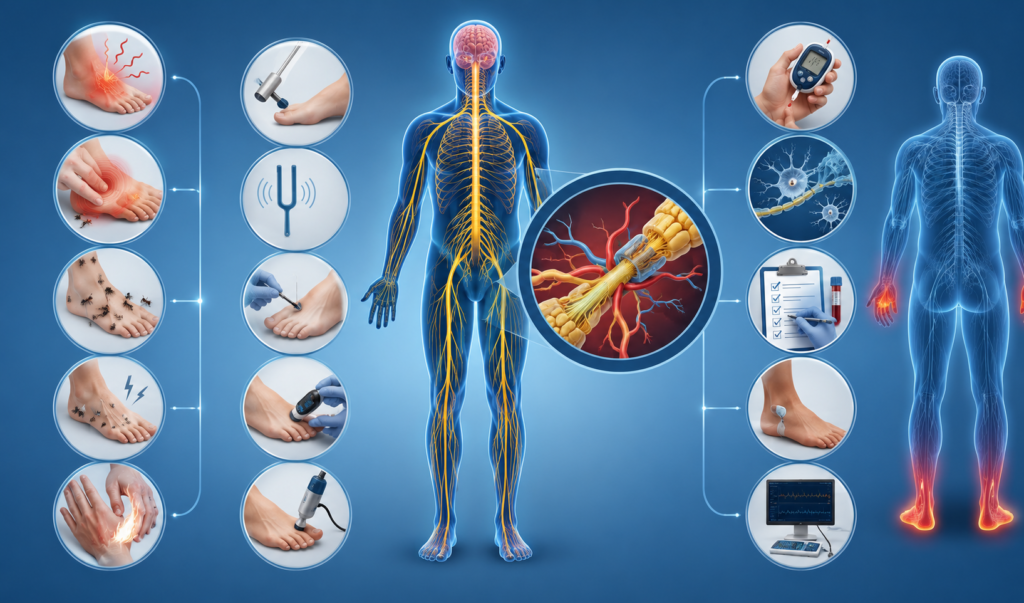
To code E11.42, the medical record must reflect the condition. Medical coders cannot diagnose patients. You can only translate what the physician has documented.
Knowing the symptoms and diagnostic criteria helps you spot the keywords needed to justify the E11.42 diagnosis code.
Common Clinical Symptoms
Providers will often note specific patient complaints in the subjective portion of their clinical notes. Look for the following symptoms:
- Numbness or reduced ability to feel pain or temperature changes.
- A tingling or burning sensation, especially in the feet and legs.
- Sharp pains or cramps.
- Increased sensitivity to touch.
- Muscle weakness.
- Loss of reflexes, particularly in the ankle.
Diagnostic Testing
Physicians confirm diabetic polyneuropathy through clinical exams and specialized testing. Your documentation might include references to:
- Monofilament testing: Checking for loss of protective sensation in the feet.
- Nerve conduction studies (NCS): Measuring how fast electrical signals move through the nerves.
- Electromyography (EMG): Assessing how well muscles respond to nerve signals.
- Vibration testing: Using a tuning fork to assess nerve function.
If you see these tests paired with a Type 2 diabetes diagnosis, you should look closely for the polyneuropathy determination. Missing this connection is one of the leading reasons claims get denied — learn more about why medical claims get denied and how to fix them.
How to Code E11.42 Correctly

Applying this code requires attention to detail. Follow these steps to ensure clean claim submissions.
Step 1: Verify the Diabetes Type
Confirm the patient has Type 2 diabetes. If the documentation says “Type 1 diabetes,” you must use the E10 category instead. If the record just says “diabetes,” ICD-10 guidelines default to Type 2 (E11), but it is always best practice to query the provider for specificity.
Step 2: Look for the Causal Link
The physician must document a relationship between the diabetes and the polyneuropathy. Phrases like “diabetic polyneuropathy,” “polyneuropathy due to diabetes,” or “diabetes with polyneuropathy” establish this link.
Under current ICD-10 guidelines, the word “with” is interpreted to mean “associated with” or “due to.” If both conditions are documented, the causal relationship is presumed unless the provider explicitly states the neuropathy is from another cause (like chemotherapy or alcohol abuse).
Step 3: Check for Additional Codes
Review the medical record to see if the patient requires additional codes. For example, if the patient has a diabetic foot ulcer caused by the neuropathy, you will need to add a code for the ulcer (L97 category) to complete the clinical picture. Submitting clean, complete claims is a core part of professional claims submission — ensure your process is airtight.
Common Coding Mistakes
- Using unspecified codes: Defaulting to E11.9 (Type 2 diabetes without complications) when the provider documented polyneuropathy.
- Double coding: Coding the diabetes (E11.9) and the neuropathy (G62.9) separately instead of using the combination code.
- Ignoring the primary cause: Using E11.42 when the provider clearly stated the polyneuropathy was caused by a vitamin deficiency, not the diabetes.
These mistakes lead to claim rejections that drain your practice’s revenue. Practices of all sizes can benefit from medical billing services built for small practices to prevent exactly these errors.
E11.42 vs. E11.40: Key Differences
One of the most frequent points of confusion for medical coders is choosing between E11.40 and E11.42. Both deal with nerve issues in Type 2 diabetics, but their specificity levels differ.
Here is a breakdown to help you make the right choice.
| Feature | ICD-10 Code E11.40 | ICD-10 Code E11.42 |
| Description | Type 2 diabetes mellitus with diabetic neuropathy, unspecified | Type 2 diabetes mellitus with diabetic polyneuropathy |
| Nerve Involvement | Unspecified or generalized nerve damage | Widespread peripheral nerve damage (multiple nerves) |
| When to Use | Provider documents “neuropathy” without further detail | Provider specifically documents “polyneuropathy” |
| Specificity Level | Low | High |
| Audit Risk | Higher (payers prefer specific diagnoses) | Lower (provides a clear clinical picture) |
If you see E11.40 frequently used in your practice, it might be time for clinical documentation improvement (CDI) education. Encourage your providers to specify the type of neuropathy whenever possible. Poor specificity is a leading driver of accounts receivable (AR) management problems — the more accurate your initial coding, the healthier your AR stays.
Expert Insights Best Practices for Coding E11.42

To truly master this code, you need insights from the trenches. Here are a few best practices from senior medical coders and billing specialists.
Query When in Doubt
Never guess. If a chart notes “burning feet” and “diabetes” but never formally connects them or diagnoses neuropathy, you cannot code E11.42. Send a polite, non-leading query to the provider asking them to clarify the diagnosis. This simple habit can prevent a wave of claim denials that require costly rework.
Understand the “With” Guideline
The ICD-10 Alphabetic Index dictates that the word “with” implies a cause-and-effect relationship. If a patient is diagnosed with Type 2 diabetes and polyneuropathy in the same encounter, you assume they are linked and use E11.42, unless the doctor explicitly links the polyneuropathy to a different disease process.
Audit Your Own Work
Before finalizing a batch of charts, do a quick review. Did you capture all manifestations of the diabetes? Did you use the highest level of specificity? Self-auditing is the fastest way to reduce denial rates and improve your coding accuracy. If your team needs additional support, consider outsourcing your medical billing to certified coders who specialize in complex diagnosis coding.
Conclusion
Understanding the E11.42 diagnosis code is important for healthcare providers to ensure correct medical documentation and billing. Proper identification of this condition helps improve patient care and supports accurate insurance claims for diabetes-related complications. A reliable Revenue Cycle Management partner can help your practice stay compliant, reduce denials, and maximize reimbursements. Explore all available medical billing and coding services at Revenue Billing Solutions to find the right fit for your practice.
FAQs
Is E11.42 a billable code?
Yes, E11.42 is a specific, valid, and billable ICD-10-CM code. It can be used to indicate a diagnosis for reimbursement purposes on medical claims.
Can I code E11.42 and a separate neuropathy code together?
No. E11.42 is a combination code that already includes the polyneuropathy. Adding a separate code from the G-chapter for the same condition is redundant and may cause a claim denial. Review our guide on why medical claims get denied to avoid common pitfalls.
What if the patient has both Type 1 and Type 2 diabetes?
A patient cannot have both Type 1 and Type 2 diabetes simultaneously. If the documentation is contradictory, you must query the provider to determine the correct underlying condition before assigning a code.
Does E11.42 cover diabetic autonomic neuropathy?
No. Autonomic neuropathy affects internal organs (like the heart or digestive tract). For Type 2 diabetes with autonomic (poly)neuropathy, you would use code E11.43 instead.
What happens if the physician only writes “diabetic nerve damage”?
If the documentation is vague, the most appropriate code is often E11.40 (diabetic neuropathy, unspecified). However, best practice is to query the physician for more specific details regarding the exact nature of the nerve damage.