
Anemia ICD-10 codes are standardized medical codes used to classify different types of anemia for diagnosis, treatment, and healthcare billing. These codes help healthcare providers accurately document conditions such as iron deficiency anemia, aplastic anemia, and other blood disorders.
Anemia ICD-10 Code Quick-Reference Table

Bookmark this. It puts every major anemia type, its code, and billable status in one scannable view something most coding pages scatter across separate entries.
| Anemia, unspecified | D64.9 | Yes | Default when type isn’t documented |
| Iron deficiency anemia, unspecified | D50.9 | Yes | Iron deficiency confirmed, no further detail |
| Iron deficiency anemia, secondary to chronic blood loss | D50.0 | Yes | Ongoing slow bleed (e.g., ulcer, heavy periods) |
| Sideropenic dysphagia | D50.1 | Yes | Iron deficiency with swallowing trouble |
| Vitamin B12 deficiency anemia | D51.- | Varies | Some need a 4th character |
| Folate deficiency anemia | D52.- | Varies | Diet- or drug-related |
| Nutritional anemia, unspecified | D53.9 | Yes | Catch-all nutritional, not the same as D64.9 |
| Acute posthemorrhagic (blood loss) anemia | D62 | Yes | Sudden, significant blood loss |
| Anemia in other chronic diseases | D63.8 | Yes | Code the underlying disease first |
| Hereditary sideroblastic anemia | D64.0 | Yes | Inherited form |
| Anemia due to antineoplastic chemotherapy | D64.81 | Yes | Chemo-induced anemia |
| Iron deficiency without anemia | E61.1 | Yes | Low iron, normal red blood cell count |
Keep this handy, and you’ll cut lookup time on most anemia claims.
What Code Family Does Anemia Fall Under in ICD-10?
Anemia mostly lives in the D50–D64 block of ICD-10-CM, tucked inside “Diseases of the blood and blood-forming organs and certain disorders involving the immune mechanism.” That’s your home base.
Within that block, the codes break into three handy sub-ranges:
- D50–D53 Nutritional anemias (iron, B12, folate)
- D55–D59 Hemolytic anemias (red blood cells breaking down too fast)
- D60–D64 Aplastic and other anemias (including the famous D64.9)
One important exception: not every iron-related code lives here. E61.1 (iron deficiency) sits over in the endocrine and nutritional chapter (E00–E89). That tiny detail trips up a lot of coders more on it below. A structured medical billing audit one of the fastest ways to catch these classification errors before payers do.
Now let’s break down each family.
Nutritional Anemia Codes (D50–D53)
These cover anemia caused by a shortage of something your body needs to build healthy red blood cells usually iron, vitamin B12, or folate.
| D50.0 | Iron deficiency anemia secondary to chronic blood loss |
| D50.1 | Sideropenic dysphagia |
| D50.8 | Other iron deficiency anemias |
| D50.9 | Iron deficiency anemia, unspecified |
| D51.- | Vitamin B12 deficiency anemia |
| D52.- | Folate deficiency anemia |
| D53.9 | Nutritional anemia, unspecified |
Iron Deficiency Anemia (D50)
This is the most common anemia worldwide, so you’ll see D50 a lot. The body runs low on iron, so it can’t make enough hemoglobin the iron-rich protein that carries oxygen in your blood.
- D50.0 secondary to chronic blood loss anemia (think bleeding ulcers or heavy menstrual periods)
- D50.1 sideropenic dysphagia (iron deficiency that affects swallowing)
- D50.8 other iron deficiency anemias
- D50.9 iron deficiency anemia, unspecified (iron deficiency confirmed, but no further detail)
Vitamin B12 and Folate Deficiency Anemia (D51, D52)
When the shortage is a vitamin rather than iron, you shift codes.
- D51 vitamin B12 deficiency anemia (includes pernicious anemia under D51.0)
- D52 folate deficiency anemia (dietary, drug-induced, or otherwise)
Both families often need a fourth character, so check the cause before you finalize.
Other Nutritional Anemia (D53)
D53.9 (nutritional anemia, unspecified) is a tempting catch-all but careful. It carries an Excludes1 note for “anemia NOS (D64.9).” That means D53.9 and D64.9 can’t be used for the same condition. Pick the one the documentation actually supports.
Hemolytic Anemia Codes (D55–D59)
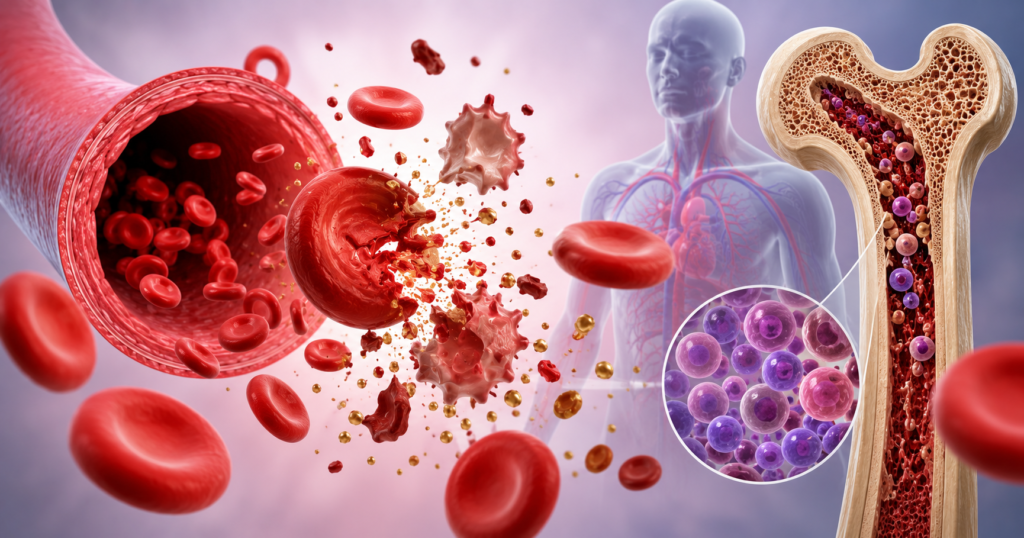
Hemolytic anemia happens when red blood cells get destroyed faster than the body can replace them. ICD-10-CM splits these into acquired and hereditary types.
- D55 anemia due to enzyme disorders
- D56 thalassemia
- D57 sickle-cell disorders
- D58 other hereditary hemolytic anemias
- D59 acquired hemolytic anemia
Quick note on two famous conditions: sickle cell anemia codes to D57, and thalassemia codes to D56 not the generic anemia codes. Many coders default to D64.9 here out of habit. Don’t. These have their own homes.
Aplastic and Other Anemia Codes (D60–D64)
This range holds bone marrow failure anemias plus the everyday workhorse codes you’ll use constantly.
| D62 | Acute posthemorrhagic anemia (acute blood loss) |
| D63.8 | Anemia in other chronic diseases classified elsewhere |
| D64.0 | Hereditary sideroblastic anemia |
| D64.81 | Anemia due to antineoplastic chemotherapy |
| D64.9 | Anemia, unspecified |
Acute Posthemorrhagic Anemia (D62)
D62 is your code for acute blood loss anemia a sudden, significant bleed, like after surgery or trauma. It carries an Excludes1 note for “anemia due to chronic blood loss (D50.0),” which matters in mixed scenarios (we’ll untangle that shortly).
Anemia in Chronic Diseases (D63.8)
D63.8 covers anemia tied to another long-term illness. This is manifestation coding: code the underlying condition first, then add D63.8. Skipping the sequencing is a fast track to a denial.
Other Specified Anemias (D64.0–D64.89)
Two you’ll meet often:
- D64.0 hereditary sideroblastic anemia (inherited)
- D64.81 anemia due to antineoplastic chemotherapy (chemo-induced)
When the chart names the cause, these specific codes beat the generic default every time.
Anemia, Unspecified (D64.9)
D64.9 is the most commonly used billable code for anemia and the most overused. It means anemia is documented, but the type isn’t. It’s perfectly valid when detail genuinely doesn’t exist. The problem starts when coders reach for it out of speed rather than necessity. Treat it as a fallback, not a first choice.
Iron Deficiency vs. Iron Deficiency Anemia: E61.1 vs. D50
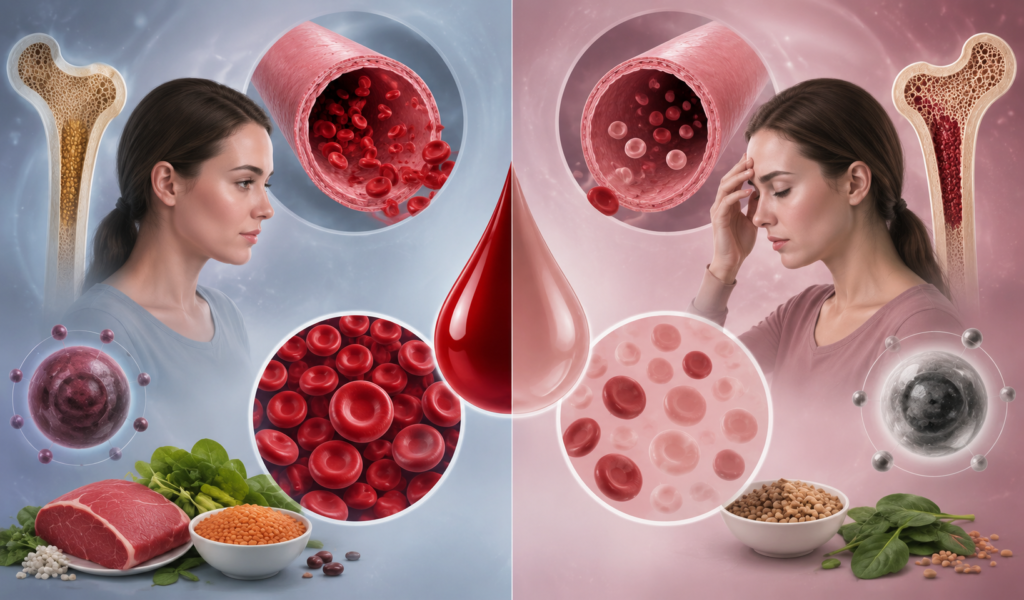
Here’s a distinction your competitors skip and one that quietly causes denials. Iron deficiency and iron deficiency anemia are not the same thing in ICD-10-CM.
| What it means | Low iron, but red blood cell count is still normal | Low iron has actually caused anemia |
| Telltale sign | Low serum ferritin, normal hemoglobin | Low ferritin and low hemoglobin |
| Code chapter | Endocrine/nutritional (E00–E89) | Blood diseases (D50–D64) |
| Billable | Yes | Yes |
Here’s the catch: E61.1 carries an Excludes1 note for iron deficiency anemia (D50.-). That means you can’t code both for the same iron problem. If anemia has developed, you’re in D50 territory. If iron is low but the blood count is fine, you’re in E61.1.
A simple test: did the patient actually develop anemia, or just low iron? Let the hemoglobin answer it.
When to Use D64.9 vs. a Specific Anemia Code
D64.9 is convenient. It’s also a payer magnet for scrutiny. Use this quick decision logic before you commit:
- Check for a documented type. Iron deficiency? B12? Folate? If named, use the specific code (D50, D51, D52).
- Check for a cause. Blood loss, chemotherapy, chronic kidney disease? Each has its own code or sequencing rule.
- Check the acuity. Acute, chronic, or acute-on-chronic? That changes everything (especially D62 vs D50.0).
- Still nothing? Only then default to D64.9 (anemia, unspecified, ICD-10).
Why care so much? Overusing D64.9 invites downcoding and audits. It signals incomplete documentation, and payers notice patterns. When you can support your claims with specificity, your claims are clearer and your reimbursement holds up. Specificity isn’t busywork — it’s protection.
Documentation Requirements for Accurate Anemia Coding
You can only code what the provider documents. When notes are thin, you’re forced into a less specific and lower-value code. Use this checklist to spot gaps before they cost you:
- Type Is the anemia iron deficiency, B12, folate, hemolytic, or aplastic?
- Cause Blood loss, chronic disease, medication, or chemotherapy?
- Acuity Acute, chronic, or acute-on-chronic?
- Related conditions: chronic kidney disease, malignancy, pregnancy, ulcer?
- Lab support Hemoglobin, low serum ferritin, or other confirming values?
Two coding guidelines worth remembering: watch for “Code First” notes (they tell you to sequence an underlying cause before the anemia) and “Use Additional” notes (they prompt a supporting code, like the drug in chemo-induced anemia).
When a detail is missing, query the provider. A two-minute query beats a denied claim every time.
Common Anemia Coding Mistakes (and How to Avoid Them)

These slip-ups keep showing up in audits. Here’s how to dodge each one:
- Defaulting to D64.9 too fast. Why it’s wrong: it ignores documented specifics and invites scrutiny. Fix: run the decision steps above before reaching the unspecified option.
- Violating the D62 / D50.0 Excludes1 rule. Why it’s wrong: coders assume they conflict and drop one of them. Fix: in true acute-on-chronic cases, both are reported (see the next section).
- Coding iron deficiency as anemia. Why it’s wrong: E61.1 (low iron, no anemia) is not D50. Fix: confirm hemoglobin actually dropped.
- Ignoring CKD sequencing. Why it’s wrong: anemia in chronic disease needs the underlying condition coded first. Fix: sequence the chronic kidney disease code, then the anemia code.
- Treating D53.9 as a universal catch-all. Why it’s wrong: it has an Excludes1 link to D64.9. Fix: match the code to the documented nutritional cause.
- Forgetting sickle cell and thalassemia have their own codes. Why it’s wrong: they belong in D57 and D56, not the generic range. Fix: code the named condition.
How Do You Code Acute on Chronic Blood Loss Anemia?
This one stumps a lot of coders, because both relevant codes carry Excludes1 notes pointing at each other. So how do you handle a patient with, say, both a chronic bleed and a sudden acute drop?
ICD-10-CM classifies acute blood loss anemia to D62 and chronic blood loss anemia to D50.0. An Excludes1 note at each code references the other which seems to forbid using them together.
But here’s the clear answer competitors lock behind a paywall: per AHA Coding Clinic guidance (2019, Issue 3), when documentation supports both an acute and a chronic component, you assign both D62 and D50.0. The Excludes1 notes don’t apply when the two conditions genuinely coexist as separate clinical events.
The quick steps:
- Confirm the chart documents both acute and chronic blood loss.
- Assign D62 for the acute component.
- Assign D50.0 for the chronic component.
- Sequence based on the reason for the encounter.
From the Coding Desk Expert Insight on Anemia Code Selection
After years of auditing anemia claims, a few patterns repeat so often they’re almost predictable. Here’s where coders actually lose money and how to stop it.
The biggest leak is D64.9 overuse. I’ve reviewed batches where unspecified anemia made up the bulk of anemia codes, yet the charts clearly documented iron deficiency or blood loss. The codes were “right” technically, but the specific detail was sitting right there in the note, unused. Payers spot that pattern, and it draws audits.
The second pattern is the E61.1 mix-up. Time and again, a patient with low iron but normal hemoglobin gets coded as iron deficiency anemia. It’s a small slip with real consequences when a payer reviews the labs and the red blood cells look fine.
A few hard-won tips:
- Query early, query specifically. When acuity or cause is missing, send a targeted question not a vague one. “Is this anemia acute, chronic, or both?” gets faster answers.
- Let the labs lead. Hemoglobin and low serum ferritin usually settle the E61.1-vs-D50 debate before you even ask.
- Defend D64.9 when it’s genuinely correct. Sometimes the documentation truly offers nothing more. That’s fine just make sure the note backs it up if a payer asks.
Specificity isn’t about chasing perfection. It’s about coding what’s real, defending what you submit, and protecting clean claims.
Conclusion
Understanding anemia ICD-10 codes is essential for accurate medical documentation and insurance claims. Using the correct code ensures proper diagnosis reporting, streamlined billing processes, and improved patient care management across healthcare settings.
FAQs
What is the ICD-10 code for anemia, unspecified?
The code is D64.9. It’s a billable, specific ICD-10-CM code used when anemia is documented but the type isn’t. Use it only when no further detail is available in the record.
Is D64.9 a billable ICD-10 code?
Yes. D64.9 is a billable/specific ICD-10-CM code valid for reimbursement. The current edition became effective October 1, 2025, with no changes from prior years — it’s been stable since ICD-10-CM launched.
What is the ICD-10 code range for anemia?
Most anemia ICD 10 codes fall within D50–D64, under diseases of the blood. One key exception is E61.1 (iron deficiency), which lives in the endocrine and nutritional chapter because it isn’t anemia itself.
What is the ICD-10 code for iron deficiency anemia?
Use the D50 family, most often D50.9 (iron deficiency anemia, unspecified) or D50.0 for cases secondary to chronic blood loss. Don’t confuse these with E61.1, which means low iron without anemia.
What is the ICD-10 code for acute blood loss anemia?
The code is D62 (acute posthemorrhagic anemia). It applies to sudden, significant blood loss, such as after surgery or trauma. Watch the Excludes1 note tied to chronic blood loss anemia (D50.0).
How is anemia due to chronic kidney disease coded?
Sequence the chronic kidney disease code first, then add the anemia code — often D63.8 (anemia in other chronic diseases classified elsewhere). This follows the “Code First” instruction and keeps your claim compliant.