
Bundling and unbundling in medical billing are important concepts that directly affect claim accuracy, compliance, and reimbursement. Bundling refers to combining related medical services into a single billing code, while unbundling involves billing those services separately when they should be reported together. Understanding the difference helps healthcare providers avoid claim denials, reduce compliance risks, and ensure proper reimbursement from insurance companies.
What Is Bundling in Medical Billing?

Bundling is the practice of using one CPT or HCPCS Level II code to cover multiple components of a single procedure, instead of billing each component on its own line.
Think of it like a combo meal. You don’t get separate receipts for the burger, the fries, and the drink. One price covers all three because they’re sold as a set.
Example: A surgeon performs a procedure that requires an incision, the main repair, and closing the incision afterward. The incision and closure aren’t billed as separate services they’re bundled into the surgical code, because they’re a necessary part of completing that surgery.
What Is Unbundling in Medical Billing?
Unbundling is billing the individual components of a procedure with separate codes, when payer rules say those components should be reported under one comprehensive code.
Unbundling isn’t automatically wrong. It becomes a problem when a coder splits out parts that were already included in the primary code, just to generate more billable lines.
Example: If closing that same surgical incision took unusually long and required extra skill say, due to extensive scarring that additional work may legitimately be reported with its own code and a modifier. Reported without justification, that same line item is improper unbundling.
Bundling vs. Unbundling: Side-by-Side

| Bundling | Unbundling | |
| What happens | One code covers multiple related services | Each service gets its own code |
| Default or exception? | Default assumed unless proven otherwise | Exception needs documentation + modifier |
| Reimbursement effect | Single, often lower combined payment | Higher total payment if approved |
| Risk if done wrong | Lost revenue (under-billing) | Claim denial, audit, possible fraud allegation |
| Who decides the rule | CMS via NCCI edits | Same NCCI modifier indicator determines if it’s allowed |
Getting this wrong in either direction costs money. Improper unbundling leads to claim denials and audit risk. Incorrect bundling leads to under-billing and lost revenue. Both problems are preventable with the right coding process in place.
Who Sets the Rules? CMS, NCCI, and the AMA
Two organizations govern almost every bundling decision you’ll make.
The American Medical Association (AMA) owns and publishes the CPT code set the actual codes and their official descriptions.
The Centers for Medicare & Medicaid Services (CMS) built the National Correct Coding Initiative (NCCI) specifically to stop improper billing of code combinations. Many private payers adopt NCCI logic even outside of Medicare claims.
How NCCI Procedure-to-Procedure (PTP) Edits Work
NCCI organizes related codes into pairs, then applies this logic:
- Column 1 holds the more comprehensive code, the one that gets paid.
- Column 2 holds the component code the one normally bundled into Column 1.
- CMS assigns a modifier indicator: “0” means the pair can never be unbundled; “1” means it can be unbundled under the right circumstances; “9” means the edit no longer applies.
- If both codes appear on the same claim with no valid modifier, the Column 2 code is denied.
These edits update quarterly, so a pair that’s bundled today might change next quarter.
Which Modifiers Unbundle a Code?
A modifier tells the payer why two normally-bundled codes should both be paid. Here are the ones you’ll actually use:
| Modifier | Meaning | Typical use |
| 59 | Distinct procedural service | “Last resort” modifier when no more specific one fits separate session, site, or lesion |
| XE / XS / XP / XU | More specific versions of 59 | Separate encounter, structure, practitioner, or unusual service |
| 25 | Significant, separately identifiable E/M service | A real evaluation happened beyond the decision to do a minor procedure |
| 91 | Repeat clinical lab test | Same lab test repeated for medical reasons on the same day |
| LT / RT, anatomic modifiers | Left/right or specific structure | Distinguishes the same code billed for two different sites |
Coders should not default to modifier 59 out of habit. CMS treats it as a modifier of last resort use an anatomic or global-surgery modifier first if one fits the situation better. Incorrect modifier use is one of the top reasons medical claims get denied.
Is Unbundling Illegal?
Not always but it’s one of the most heavily scrutinized billing practices in U.S. healthcare. Unbundling is legal when an NCCI edit’s modifier indicator allows it and your documentation proves the services were genuinely distinct. It becomes fraud when codes are split solely to inflate reimbursement.
Real cases show how seriously this is treated. In 2014, a major academic medical center agreed to repay $1 million after a whistleblower coder flagged that anesthesia services tied to cardiac procedures were being unbundled and billed separately when they should have been included. In another case, a California urology practice paid $1.85 million to resolve allegations that it improperly unbundled evaluation and management services to boost Medicare reimbursement.
The common thread in nearly every enforcement case: a pattern of unbundling, not a single mistake. One incorrect claim is usually treated as an error. Hundreds of similar claims, all using the same modifier to bypass the same edit, look like a scheme and under the False Claims Act, penalties can reach three times the overpayment plus per-claim fines.
Don’t Confuse This With “Bundled Payment Models”
Here’s where a lot of people get tripped up: “bundling” also describes something completely different in healthcare finance value-based bundled payment models, like CMS’s BPCI Advanced program.
CPT/NCCI bundling is about whether two procedure codes can be billed together on one claim. Bundled payment models are about whether an entire episode of care, say, a hip replacement plus 90 days of recovery, gets one lump-sum payment across multiple providers and settings.
A coder dealing with an NCCI edit and a hospital administrator negotiating a joint-replacement bundle are talking about two unrelated systems that happen to share a word. If you’re researching one, make sure you’re not accidentally reading about the other.
A Simple Decision Framework: Should You Bundle or Unbundle This Pair?

Before you append a modifier, run the code pair through these four questions:
- Is this an NCCI edit pair at all? Check the current quarterly PTP edits table. If the pair isn’t listed, normal coding rules applying this framework aren’t needed.
- What’s the modifier indicator? If it’s “0,” stop no modifier overrides this pair, no matter how distinct the services felt clinically.
- Was there a genuine distinguishing factor? Separate anatomic site, separate session, or meaningfully more time/skill than the primary procedure requires.
- Does the documentation actually say so? If the chart doesn’t clearly support a separate, distinct service, the modifier shouldn’t go on the claim regardless of what your billing software suggests.
If you can answer “yes, yes, and yes” to questions 1, 3, and 4 and the indicator from question 2 is “1” unbundling is appropriate. This decision logic is the same framework applied when our team handles claims submission on behalf of provider practices.
Real-World Bundling Examples by Specialty
| Specialty | Code pair | What determines bundling vs. unbundling |
| Ophthalmology | 66984 (cataract surgery) + 66821 (YAG capsulotomy) | Bundled by default; can unbundle with modifier 59 and laterality modifiers if performed on different eyes |
| Orthopedics | 29827 (rotator cuff repair) + 29820 (partial synovectomy) | NCCI edit pair separate billing needs clear documentation of distinct work |
| Pain management | 20610 (joint injection) + 96372 (therapeutic injection) | Modifier indicator allows unbundling with documentation; a different bundled pair (with moderate sedation code 99156) cannot be unbundled at all |
| ENT | 69421 (myringotomy) + 69436 (tympanostomy) | Can be unbundled if performed in different ears on the same date |
These specialty-specific distinctions are exactly where coding expertise matters most. For practices in surgical specialties, pairing accurate coding with proactive accounts receivable management ensures that every legitimate separate service gets collected and every bundled claim stays clean
How to Spot Unbundling on a Claim Denial
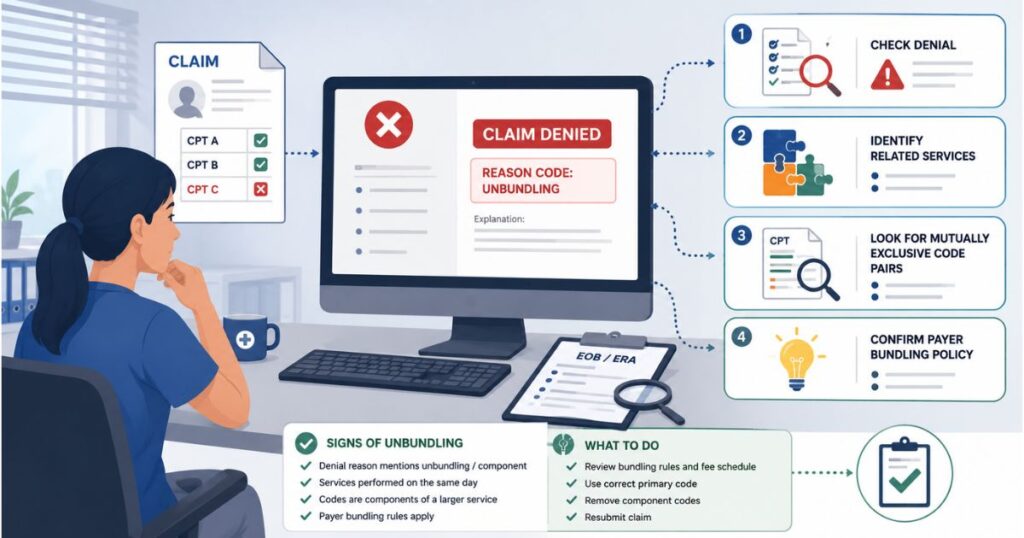
If a claim line comes back denied with CARC code CO-97, that’s the payer telling you it decided this service’s payment was already included in another procedure billed on the same claim, a classic bundling-related denial.
Seeing CO-97 repeatedly on the same code pair is a strong signal to check whether your team needs a modifier, better documentation, or simply shouldn’t be billing that pair separately at all.
Conclusion
Bundling and unbundling play a crucial role in the medical billing process. Correct coding practices help providers stay compliant with payer regulations, prevent billing errors, and improve revenue cycle management. By understanding when services should be bundled or reported separately, healthcare organizations can reduce audits, avoid penalties, and maintain accurate claim submissions.
FAQs
What is the difference between bundling and unbundling in medical billing?
Bundling combines related procedure components under one code; unbundling reports those same components as separate codes. Bundling is the default, while unbundling is only valid when NCCI rules and documentation support it.
What is an example of bundling in medical billing?
A surgical incision and its closure are typically bundled into the main surgery code, since both are routine, necessary parts of completing that procedure.
Is unbundling always fraud?
No. Unbundling is legitimate when an NCCI edit allows a modifier override and documentation proves the services were genuinely distinct. It becomes fraud when codes are split purely to increase reimbursement without medical justification.
What modifier do you use to unbundle a code?
Modifier 59 (or its more specific X-modifiers XE, XS, XP, XU) is most common, though anatomic modifiers like LT/RT or global-surgery modifiers like 25 may be more accurate depending on the situation.