
Best Medical Coding Software for Healthcare Providers streamline coding processes, reduce billing errors, and improve claim accuracy. With the right software, clinics, hospitals, and medical practices can enhance productivity, ensure compliance with coding standards, and maximize revenue. Choosing the best medical coding software is essential for efficient healthcare operations and accurate reimbursement.
What Is Medical Coding Software?

Medical coding software is a digital platform that helps healthcare organizations turn patient care into standardized billing codes quickly and accurately.
It reads clinical documentation, suggests the right codes, checks them against payer rules, and flags errors before a claim is submitted. The goal is simple: fewer mistakes, faster payments, and less manual work.
You’ll often hear two terms that get mixed up:
- Medical encoder software is a reference tool. It helps a human coder look up and confirm the correct ICD-10, CPT, or HCPCS code.
- Computer-assisted coding (CAC) software goes further. It uses natural language processing (NLP) to read clinical notes and suggest codes automatically, which the coder then reviews.
Think of an encoder as a smart dictionary and CAC as a smart assistant. Both speed up the work, but CAC does more of the heavy lifting.
How Does Medical Coding Software Work?
Most modern platforms follow the same core workflow. Here’s what happens behind the scenes:
- Ingests clinical documentation from your electronic health record (EHR), including physician notes, lab results, and procedure reports.
- Analyzes the notes using NLP and AI to understand diagnoses, treatments, and procedures.
- Suggests codes ICD-10 for diagnoses, CPT and HCPCS for procedures and services.
- Runs compliance and modifier checks to confirm codes match payer and federal rules.
- Scrubs the claim for missing data or errors before it goes out the door.
- Generates audit trails and analytics so managers can track accuracy, denials, and revenue trends.
The result? A coder who used to spend hours hunting for codes can now review AI suggestions in a fraction of the time. This efficiency is what powers a clean claims submission process.
Why Healthcare Providers Need Medical Coding Software
Manual coding is slow, error-prone, and expensive. Here’s what the right software actually fixes.
Fewer Claim Denials
Most denials trace back to coding errors, missing modifiers, or documentation gaps. Coding software catches these issues before submission, which lifts your first-pass acceptance rate and keeps revenue flowing.
Faster Reimbursement
Clean claims get paid faster. By automating code selection and scrubbing, software shortens the time between patient care and payment a lifeline for practices managing tight cash flow.
Stronger HIPAA Compliance
Payer rules and coding standards change constantly. Quality software updates automatically with ICD, CPT, and HCPCS changes, and it protects patient data with encryption and access controls to stay HIPAA-compliant.
Better Staff Productivity
When repetitive lookups disappear, your coders can focus on complex cases instead of routine entries. That means fewer bottlenecks, less burnout, and happier staff.
How to Choose Medical Coding Software (Step-by-Step)
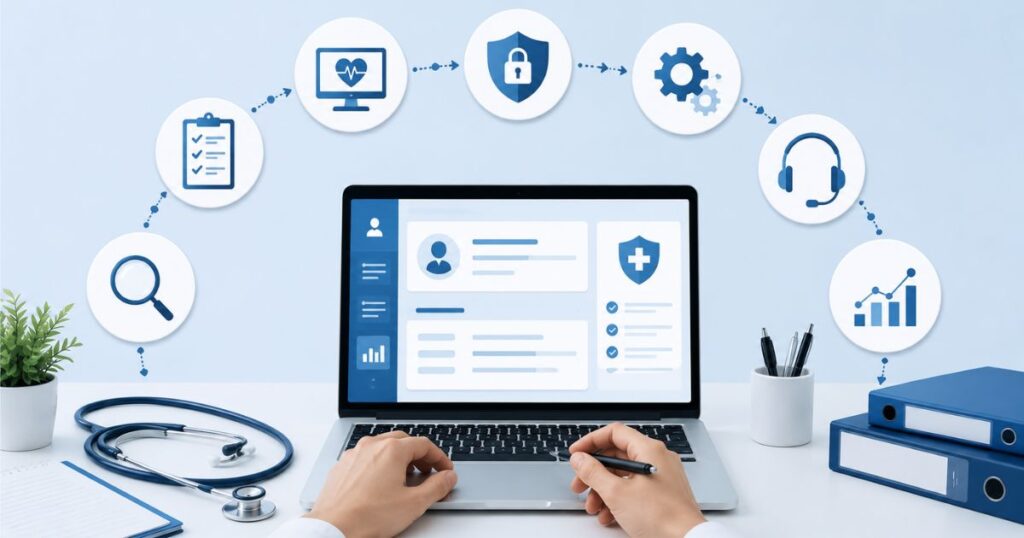
Picking the right tool isn’t about chasing the flashiest features. It’s about matching the software to your organization. Follow these six steps.
Step 1: Map Your Provider Type and Specialty
A solo dermatology practice and a 500-bed hospital have very different needs. Start by listing your specialties, claim volume, and care settings (inpatient, outpatient, or both).
Step 2: Check EHR and Billing System Integration
Your coding software should plug directly into your existing EHR and billing platform. Strong integration kills duplicate data entry and reduces errors. If a tool doesn’t connect to your Epic, Oracle Health, or MEDITECH system, keep looking.
Step 3: Evaluate AI and Automation Capabilities
Ask vendors how their AI suggests codes and how often it’s right. Look for NLP-driven suggestions, modifier recommendations, and claim scrubbing built in.
Step 4: Confirm HIPAA Compliance and Security
Any platform handling patient data must be HIPAA-compliant. Confirm it offers encryption, role-based access controls, and detailed audit logs.
Step 5: Compare Total Cost of Ownership
Look beyond the license fee. Factor in implementation, training, and maintenance. A cheaper tool that takes months to set up can cost more in the long run. For practices where buying and managing software isn’t the right fit, outsourcing billing for small practices delivers professional coding without the software overhead.
Step 6: Test Vendor Support and Scalability
Pick a vendor that responds fast and a platform that grows with you. If you plan to add locations or specialties, make sure the software can scale without a painful migration later.
Best Medical Coding Software for Healthcare Providers (Comparison)
The best medical coding software for healthcare providers depends heavily on your size and setting. Here’s a quick comparison by provider type.
| Provider Type | Top Picks | Best For |
| Large hospitals & health systems | Epic Systems, Oracle Health, Optum | Deep EHR integration, high claim volume |
| Small & mid-sized practices | NextGen, AdvancedMD | Ease of use, fast setup, affordability |
| Ambulatory surgery centers | TruBridge, Solventum | Inpatient/outpatient validation, modifier support |
| Physician & multi-specialty practices | Aptarro, Veradigm, MEDITECH | Revenue cycle automation, flexible configuration |
Large hospitals and health systems tend to favor Epic and Oracle Health because their coding modules live inside the same ecosystem as clinical staff. Optum is another popular choice for big organizations thanks to robust analytics.
Small and mid-sized practices often lean toward NextGen and AdvancedMD. Both prioritize ease of use and quick onboarding, which matters when you don’t have a dedicated IT team.
Ambulatory surgery centers benefit from TruBridge and Solventum, which handle both inpatient and outpatient encounters with strong code validation.
Physician and multi-specialty practices that want full revenue cycle automation often look at Aptarro’s RevCycle Engine, which pairs AI coding with compliance alerts and analytics. Veradigm and MEDITECH offer flexible options for groups of varying sizes.
Key Features to Look For in Medical Coding Software
Not all platforms are built the same. These are the features that separate the strong tools from the rest:
- Automated code suggestions for ICD-10, CPT, HCPCS, and DRG
- Compliance and audit tools that document every coding decision
- Modifier recommendations to prevent underpayments and rejections
- Claim scrubbing that catches errors before submission
- EHR and billing integration to eliminate duplicate data entry
- Reporting and analytics for tracking accuracy and denial trends
- Cloud-based access so your team can code securely from anywhere
If a platform is missing claim scrubbing or solid analytics, you’ll likely feel the gap fast. These are the same standards applied to every claim processed by professional medical billing companies.
Medical Coding Software vs Medical Billing Software
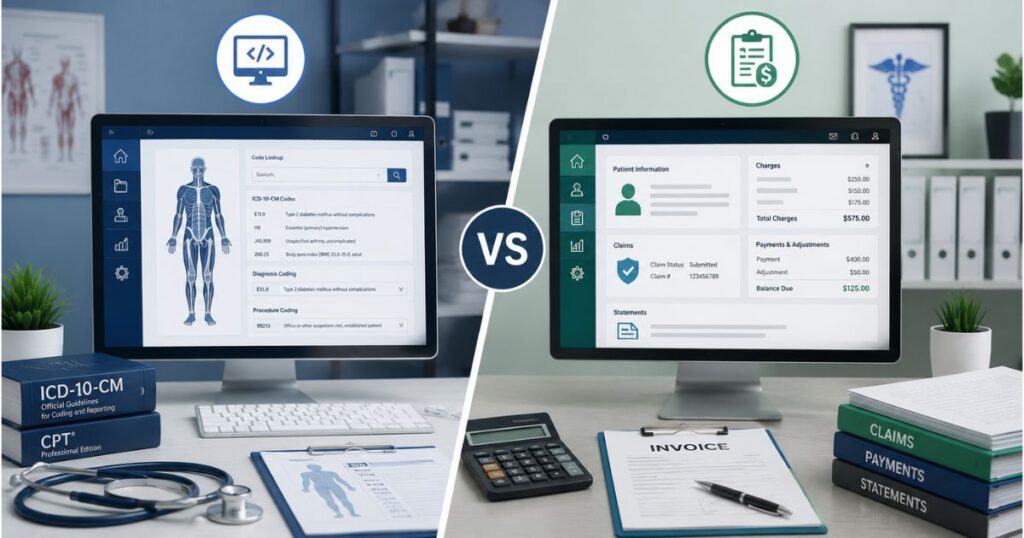
People often use these terms interchangeably, but they do different jobs.
| Medical Coding Software | Medical Billing Software |
| Translates clinical care into ICD, CPT, and HCPCS codes | Uses those codes to create and submit claims |
| Focuses on accuracy and compliance | Focuses on payment and collections |
| Helps coders and HIM teams | Helps billers and the front office |
| Reduces coding errors and denials | Manages invoices, payments, and follow-ups |
In short: coding software gets the codes right, and billing software gets you paid. Many platforms like Aptarro and AdvancedMD combine both into one revenue cycle system, which simplifies your workflow.
How Medical Coding Software Reduces Claim Denials
Denials usually come from a handful of preventable problems. Coding software tackles each one.
When a code doesn’t match the documentation, the software flags it. When a modifier is missing, it suggests one. When a claim has incomplete data, the scrubbing tool catches it before submission.
That chain of checks adds up. Each error you catch upstream is one less denial, one less appeal, and one less delay in getting paid.
Common denial causes that software prevents:
- Mismatched ICD-10 and CPT codes
- Missing or incorrect modifiers
- Documentation that doesn’t support the code
- Outdated codes after a regulatory change
Clinical Documentation Improvement (CDI)
Even the best software can’t code what isn’t documented. That’s where clinical documentation improvement comes in.
CDI programs make sure physician notes capture the full clinical picture. When documentation is clear and complete, coding software has better raw material to work with and your denial rate drops. Pairing strong CDI with coding software is one of the most effective ways to protect revenue.
AI and Autonomous Coding: Where the Industry Is Headed
AI coding is having a real moment, as the Healthcare Financial Management Association (HFMA) has noted. But there’s an important distinction buyers need to understand.
Computer-assisted coding (CAC) suggests codes that a human coder reviews and approves. The human stays in the loop on every chart.
Autonomous coding goes a step further. It uses AI to read documentation, apply coding rules, and submit claims without human review but only on confident, straightforward cases. Complex charts still route to a coder. That’s the “human-in-the-loop” model most vendors use today.
So how accurate is it? Accuracy varies by vendor and specialty, and the strongest results tend to appear in high-volume, repetitive case types like radiology. The honest answer: AI handles routine coding well, but it doesn’t replace expert coders for nuanced cases at least not yet.
Is AI coding software HIPAA-compliant? It can be, and reputable vendors build to that standard. Look for encryption, access controls, audit trails, and regular bias audits. HIM teams should still review autonomous systems regularly to confirm accuracy and catch drift.
The bottom line on ROI: autonomous coding can cut costs and speed up reimbursement when it fits your case mix. Start with a pilot, measure accuracy against your coders, and expand from there.
What 20+ Years in Healthcare Coding Taught Us
Here’s something two decades in healthcare makes clear: software is only as good as the documentation and the people behind it.
I’ve watched practices buy expensive coding tools, then struggle because their physician notes were vague or their staff never got proper training. The tool wasn’t the problem. The foundation was.
One mid-sized practice I worked with cut its time-to-hire for clean claims dramatically not by switching software, but by tightening its CDI process and training coders to trust (and verify) AI suggestions. Within a few months, their first-pass acceptance climbed and rework dropped.
The lesson? Choose your software carefully, but invest just as much in documentation and people. Technology amplifies a good process. It can’t fix a broken one.
Conclusion
The best medical coding software can significantly improve workflow efficiency, coding accuracy, and revenue cycle management for healthcare providers. By selecting a solution that offers up-to-date coding databases, automation features, and compliance support, healthcare organizations can reduce claim denials and focus more on delivering quality patient care. Whether you need expert claims submission,proactive denial management, or strong accounts receivable management, Revenue Billing Solutions has the coding and billing expertise your practice needs.
FAQ
What is the best medical coding software for small practices?
NextGen and AdvancedMD are strong choices for small practices. Both offer automated code suggestions, compliance checks, and easy setup without the complexity (or price tag) of enterprise systems built for large hospitals.
How much does medical coding software cost?
Costs vary widely by practice size and features. Entry-level AI coding tools for small practices often start around $500 to $1,000 per month, while enterprise platforms cost significantly more. Always factor in implementation, training, and maintenance on top of licensing.
Is AI medical coding software HIPAA compliant?
It can be. Reputable AI coding platforms are built to meet HIPAA standards with encryption, access controls, and audit logs. Always confirm a vendor’s compliance certifications and ask how they protect patient data before you buy.
What’s the difference between CAC and encoder software?
An encoder is a reference tool that helps a human coder look up the correct code. Computer-assisted coding (CAC) goes further, using NLP to read clinical notes and suggest codes automatically for the coder to review.
Can medical coding software reduce claim denials?
Yes. By catching mismatched codes, missing modifiers, and documentation gaps before submission, coding software improves first-pass acceptance rates and reduces denials a major win given that denial rates now sit between 10% and 15%.