
Laparoscopic cholecystectomy is a minimally invasive surgical procedure used to remove the gallbladder. Understanding the CPT codes for laparoscopic cholecystectomy procedures is essential for proper medical billing, reimbursement, and claim compliance. The most commonly used CPT codes for laparoscopic cholecystectomy vary depending on whether imaging, exploration, or additional procedures are performed during surgery.
What Is a Laparoscopic Cholecystectomy? (Clinical Context for Coders)
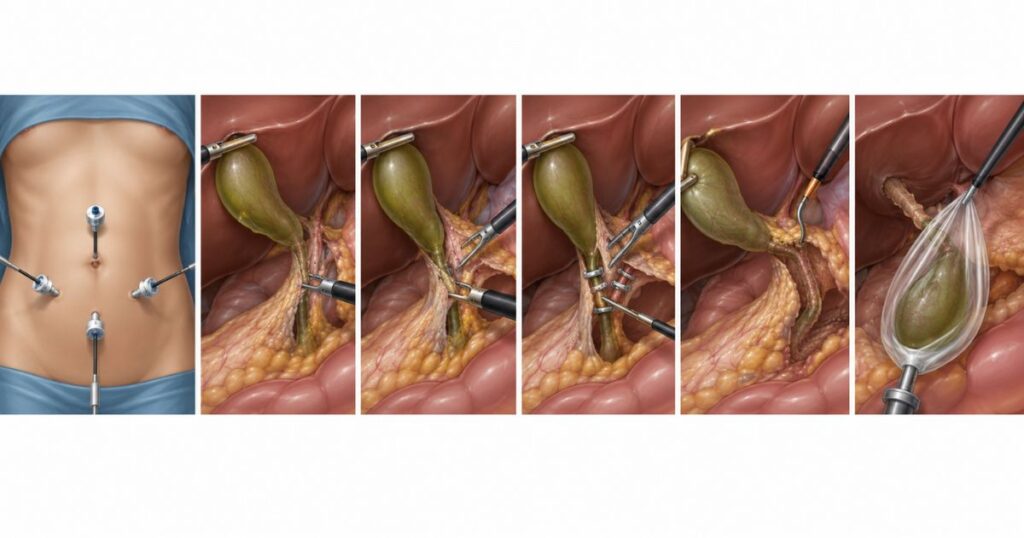
A laparoscopic cholecystectomy is the minimally invasive removal of the gallbladder. The surgeon works through small abdominal incisions using a laparoscope, rather than one large open incision.
Why does the clinical picture matter to you as a coder? Because the operative report not the surgeon’s quick summary drives code selection. Knowing what triggers the procedure also helps you pair the right ICD-10 diagnosis.
Common indications include:
- Cholelithiasis (gallstones)
- Acute and chronic cholecystitis (gallbladder inflammation)
- Gallstone pancreatitis
- Biliary dyskinesia (poor gallbladder function)
- Gallbladder polyps
One important note up front: robotic-assisted procedures use the same CPT codes as standard laparoscopic ones. There’s no separate robotic code. More on that later.
What Are the CPT Codes for Laparoscopic Cholecystectomy?
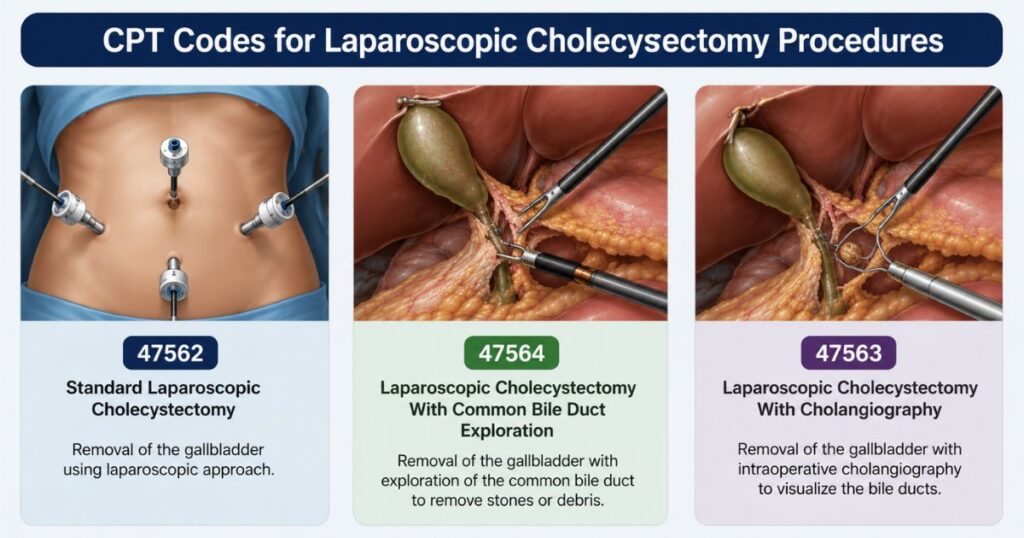
The three primary codes live in the 47560–47579 range. The golden rule? They follow a hierarchy. Each higher-level code includes the work of the one below it, so they’re mutually exclusive on the same claim.
Pick the single code that reflects the highest level of service actually performed and documented.
| CPT Code | Description | Includes Cholangiography? | Includes Bile Duct Exploration? |
| 47562 | Standard laparoscopic cholecystectomy | No | No |
| 47563 | Laparoscopic cholecystectomy with cholangiography | Yes | No |
| 47564 | Laparoscopic cholecystectomy with bile duct exploration | Yes (implied) | Yes |
CPT 47562 Standard Laparoscopic Cholecystectomy
This is your bread-and-butter code. Use it for gallbladder removal only no cholangiography, no bile duct exploration, no conversion to open.
What the procedure typically involves:
- Port placement through small incisions
- Identification of the cystic duct and artery
- Dissection and removal of the gallbladder from the liver bed
- Extraction through a small incision
Documentation requirements for 47562:
- Surgical approach confirmed as laparoscopic
- No mention of contrast injection or fluoroscopic imaging
- No active bile duct exploration documented
- Procedure completed without conversion to open
Real-world coding note: Minor adhesiolysis is included in 47562. Don’t add a separate code for it. The only exception is when complexity is genuinely extreme then Modifier 22 may be justified with supporting documentation.
Here’s a detail many guides miss: incidental findings like minor omental adhesions stay bundled inside 47562. Routine work to free up the surgical field doesn’t earn an extra code. Save the separate billing and the Modifier 22 case for the truly unusual.
CPT 47563 Laparoscopic Cholecystectomy With Cholangiography
Step 47563 covers everything in 47562 plus intraoperative cholangiography (IOC).
So what is IOC? The surgeon injects contrast dye into the cystic duct, takes fluoroscopic X-ray images, and visualizes the biliary anatomy in real time.
Surgeons use IOC to:
- Detect bile duct stones (choledocholithiasis)
- Identify anatomical variations
- Prevent bile duct injury
- Evaluate duct obstruction
Documentation requirements for 47563:
- Confirmed contrast injection not ICG dye (this matters, see below)
- Fluoroscopic imaging performed and reviewed
- Imaging interpretation documented in the operative report
- Cholangiocatheter placement noted
Critical billing rule: When you report 47563, do not separately bill the cholangiography imaging. It’s bundled into the code. Submitting separate imaging codes triggers NCCI bundling edits and denials.
A leading cause of rejection here? Vague documentation. A note that simply says “IOC performed” with no detail on contrast injection, catheter placement, or image review will get downcoded or denied. Push for specifics.
CPT 47564 Laparoscopic Cholecystectomy With Common Bile Duct Exploration
This is the highest-level code in the trio. Reserve it for cases that involve active surgical treatment of the bile duct.
Common clinical scenarios:
- Choledocholithiasis requiring stone removal
- Biliary strictures
- Stones impacted in the common bile duct
Qualifying exploration includes:
- Stone extraction
- Balloon sweep of the duct
- Basket retrieval
- Choledochoscopy
- Direct duct flushing
Documentation requirements for 47564:
- Active exploration or treatment explicitly documented
- Clear distinction between inspection and active intervention
- Supporting notes, operative photos (if available), and anesthesia records
Here’s the trap: Inspecting or visualizing the bile duct is not exploration for billing purposes. If the surgeon only looked, you don’t have 47564. Upcoding visualization to exploration is one of the fastest ways to fail an audit.
Edge Cases: The Coding Scenarios Most Guides Miss
This is where the money and the compliance risk really lives. Four scenarios trip up even experienced coders.
Edge Case 1: ICG/Fluorescence Imaging Does It Qualify for CPT 47563?
Short answer: No.
Surgeons increasingly use indocyanine green (ICG) dye with near-infrared fluorescence imaging to light up biliary structures. Because it shows the anatomy, many teams assume it triggers 47563.
It doesn’t.
According to the American College of Surgeons (ACS Bulletin, August 2022), when ICG dye is injected and fluorescent imaging is used to view structures during dissection, you report 47562 not 47563.
Why? ICG fluorescence does not include the components that define cholangiography:
- No contrast injection
- No fluoroscopic X-ray
- No cholangiocatheter placement
- No film review
As ACS put it, fluorescent imaging “does not confidently demonstrate choledocholithiasis, show the intrahepatic branches, or detect drainage into the duodenum like a traditional cholangiogram.”
Facility billing note: HCPCS Level II code C9776 (intraoperative near-infrared fluorescence imaging of major extra-hepatic bile ducts) was established effective April 2021 for hospital outpatient/facility billing under OPPS. But it is not a physician fee schedule code. Always confirm payer-specific guidance before reporting it.
Watch out: ICG fluorescence ≠ cholangiography. Defaulting to 47563 here is one of the most common—and most preventable coding errors.
Edge Case 2: Conversion From Laparoscopic to Open Surgery
When a laparoscopic case converts to open due to complications, report only the completed open procedure.
Per the NCCI Policy Manual, the failed laparoscopic attempt and any diagnostic laparoscopy are not separately reportable.
The relevant open codes:
- 47600 Open cholecystectomy
- 47605 Open cholecystectomy with cholangiography
- 47610 Open cholecystectomy with bile duct exploration
Make sure the documentation explains why the conversion happened dense adhesions, bleeding, severe inflammation. That reason supports your code choice and protects you on audit.
Edge Case 3: Liver Biopsy Performed Alongside Cholecystectomy
If a liver biopsy is performed laparoscopically during a laparoscopic cholecystectomy, report unlisted code 47379 (Unlisted laparoscopic procedure, liver).
This surprises a lot of coders, so here’s the why: CPT 47001 (Biopsy of liver, needle; when done for indicated purpose at time of other major procedure) applies only to open procedures. ACS guidance and multiple CPT Assistant articles confirm 47001 can’t be used for a laparoscopic approach.
Because 47379 is unlisted, you’ll need a cover letter or report defining the nature, extent, clinical necessity, time, effort, and equipment used. Skip that, and the claim stalls.
Edge Case 4: Robotic-Assisted Laparoscopic Cholecystectomy
There is no separate CPT code for robotic cholecystectomy. Robotic assistance is part of the surgical technique—not a separately reportable service.
Report 47562, 47563, or 47564 based on what was actually performed during the robotic case.
Compliance tip: Document the robotic system used in the operative report for audit readiness, even though it doesn’t change the code.
ICD-10 Diagnosis Code Pairings for Laparoscopic Cholecystectomy
Your CPT code only tells half the story. The right ICD-10 pairing supports medical necessity and keeps claims clean.
| ICD-10 Code | Description | Commonly Paired With |
| K80.00 | Calculus of gallbladder with acute cholecystitis, without obstruction | 47562, 47563 |
| K80.20 | Calculus of gallbladder without cholecystitis, without obstruction | 47562 |
| K80.50 | Calculus of bile duct without cholangitis or cholecystitis | 47564 |
| K80.42 | Calculus of bile duct with acute cholecystitis, without obstruction | 47563, 47564 |
| K81.0 | Acute cholecystitis | 47562, 47563 |
| K81.1 | Chronic cholecystitis | 47562 |
Always review the full operative report and postoperative diagnosis list not just the pre-op diagnosis before assigning ICD-10 codes.
One scenario to watch: if the surgeon finds acute cholecystitis intraoperatively but it’s missing from the postoperative diagnosis, you should still code it based on the operative findings.
Modifiers Used in Laparoscopic Cholecystectomy Billing
Modifiers tell the payer what made this case different. Use them accurately incorrect modifiers are a top trigger for general surgery audits.
- Modifier 22 (Increased Procedural Complexity): For severe adhesions or unusual anatomy. Requires detailed operative documentation to justify.
- Modifier 51 (Multiple Procedures): When more than one procedure is performed in the same session (e.g., cholecystectomy + liver biopsy).
- Modifier 59 (Distinct Procedural Service): When a normally bundled ancillary procedure is performed independently and warrants separate payment.
- Modifier 53 (Discontinued Procedure): When surgery is halted before completion due to patient safety concerns.
- Modifier 80 (Assistant Surgeon): Often overlooked. CPT codes 47562, 47563, and 47564 are eligible for assistant-at-surgery payment per ACS’s Physicians as Assistants at Surgery reference. When a second surgeon actively assists during a complex cholecystectomy, append Modifier 80 to the assistant’s claim. (Use Modifier 82 instead in a teaching setting when no qualified resident is available.)
Common Billing Errors and How to Avoid Them

Most denials on these claims come down to the same handful of mistakes. Here’s how to dodge them:
- Defaulting to 47562 when 47563 is correct Always scan the full operative note for cholangiography before assigning a code.
- Billing cholangiography separately when 47563 is reported It’s bundled. Separate billing triggers NCCI edits.
- Upcoding ICG fluorescence as 47563 ICG visualization ≠ traditional cholangiography. Report 47562.
- Billing 47001 for a laparoscopic liver biopsy 47001 is open-only. Use 47379 for the laparoscopic approach.
- Reporting the laparoscopic attempt after conversion to open Report only the completed open procedure.
- Insufficient documentation “IOC performed” with no contrast, catheter, or image-review detail will get downcoded or denied.
- Billing 47562 and 47563 together They’re mutually exclusive. The hierarchy allows only one per claim.
What Certified Coders Get Wrong Most Often
Perspective from a Certified Professional Coder (CPC, AAPC):
“The single most underreported error I see is the ICG/fluorescence misclassification. Even after ACS clarified this back in 2022, plenty of surgeons and coders still believe ICG dye qualifies for 47563. It often hasn’t been corrected at the practice level so the same wrong code keeps going out the door.”
“The second big issue is over-reliance on the procedure summary. The summary is a headline; the full operative report is the story. Code from the report, every time.”
The practical fix? Run quarterly internal audits of all laparoscopic cholecystectomy claims, checking code assignment and modifier usage. And build a surgeon-coder communication protocol for complex gallbladder cases, so questions get answered before the claim drops not after the denial.
How to Ensure Clean Claims Every Time
Use this checklist on every laparoscopic cholecystectomy claim:
- Pull the full operative report never code from a summary alone.
- Confirm the surgical approach: laparoscopic, robotic, or open.
- Check for cholangiography: Was contrast injected under fluoroscopy? Or was it ICG dye?
- Identify bile duct exploration: active intervention only not visual inspection.
- Note concurrent procedures (liver biopsy, significant adhesiolysis, etc.).
- Assign the correct CPT code based on the hierarchy.
- Apply appropriate modifiers and verify against NCCI edits.
- Match ICD-10 codes to operative findings not just the pre-op diagnosis.
- Run a pre-submission audit on this procedure type quarterly.
Conclusion
Selecting the correct CPT code for laparoscopic cholecystectomy depends on the specific services performed during the procedure. Proper documentation of cholangiography, bile duct exploration, and other surgical details ensures accurate coding, timely reimbursement, and compliance with payer requirements.
FAQs
What is the CPT code for laparoscopic cholecystectomy?
The standard code is 47562 for a routine laparoscopic gallbladder removal without additional imaging or bile duct exploration.
What is the difference between CPT 47562 and 47563?
CPT 47562 covers gallbladder removal only. CPT 47563 is used when intraoperative cholangiography contrast injection plus fluoroscopic imaging is also performed during the same surgery.
Can CPT 47562 and 47563 be billed together?
No. They’re mutually exclusive. The coding hierarchy means you select only one, based on the highest level of service performed.
Does ICG fluorescence imaging qualify as cholangiography for CPT 47563?
No. Per ACS guidance, ICG/near-infrared fluorescence imaging doesn’t meet the definition of traditional cholangiography. Report CPT 47562. Facilities may separately report HCPCS C9776 depending on payer rules.
What CPT code is used if a laparoscopic cholecystectomy is converted to open surgery?
Report only the completed open procedure (47600, 47605, or 47610). The failed laparoscopic attempt is not separately billable under NCCI guidelines.