
The global period in medical billing refers to a specific timeframe during which certain services related to a surgical procedure are included in a single payment. This period typically covers pre-operative, intra-operative, and post-operative care associated with the procedure. Healthcare providers generally cannot bill separately for routine follow-up visits and related services that fall within the designated global period. Understanding what is global period in medical billing is essential for accurate coding, billing compliance, and proper reimbursement management.
What Is the Global Period in Medical Billing? (Plain-English Definition)

Let’s break it down two ways, so it clicks no matter your experience level.
The Simple Version (For Beginners)
Picture buying a meal combo. You pay one price, and it covers the burger, the fries, and the drink. You don’t get charged again for the ketchup.
The global period works the same way. One payment covers the surgery plus the normal follow-up care that comes with it. You don’t bill again for routine check-ins during that window.
The Technical Version (For Coders)
The global period reflects a bundled payment model. The surgical fee includes pre-op, intra-op, and routine post-op services tied to the procedure.
CMS global surgery indicators tell you how many post-op days a code carries. Payer policy then confirms how those rules apply to a specific plan. Your job is to match the code, the days, and the payer rule before you submit.
Why Payers Use Global Periods
Payers use global periods to keep costs predictable and claims consistent. They expect a certain amount of routine care after surgery, so they fold it into one fee. This reduces duplicate billing and sets clear expectations for everyone.
Types of Global Periods 0-Day, 10-Day, and 90-Day Explained

Every surgical code falls into a global period length. Here’s how the three main types compare.
| Global Period | Length | Typical Use | Example CPT Codes |
| 0-day global period | Day of procedure only | Minor or endoscopic | 10040, 11042 |
| 10-day global period | Procedure + 10 days | Minor surgery | 11401, 12002 |
| 90-day global period | Day before + 90 days | Major surgery | 27447, 66984 |
The bigger the surgery, the longer the period. A 0-day global period wraps up the same day. A 90-day global period stretches across three months of expected recovery.
How to Read CMS Global Surgery Indicators
CMS assigns each code an indicator that tells you the rules at a glance. Here’s what each one means.
| Indicator | What It Means |
| 000 | Minor procedure; only same-day related care is bundled |
| 010 | Minor surgery; 10 post-op days are bundled |
| 090 | Major surgery; 1 pre-op day plus 90 post-op days are bundled |
| MMM | Maternity codes; the usual global period does not apply |
| XXX | The global concept does not apply |
| YYY | The payer decides the post-op period at pricing |
| ZZZ | The code is always part of another service’s global period |
Memorize these and you’ll save yourself a lot of guesswork. They’re your fastest clue to how a code behaves.
What’s Included vs Excluded in the Global Surgical Package?

The global surgical package is the list of services baked into that one bundled fee. Knowing what’s in and what’s out is where most money is won or lost in revenue-cycle-management.
| Included (Bundled) | Excluded (May Be Separately Billable) |
| Pre-op visit (day before major surgery) | Unrelated office visits |
| The procedure itself | Complications needing a return to the OR |
| Routine post-op care, dressing changes, suture removal | Unrelated tests and procedures |
| E/M services related to the surgery | The initial visit that decided the surgery |
A quick note on E/M services that stands for Evaluation and Management. It’s the code for a doctor’s visit where they assess and manage your care.
The Gray Areas Most Beginners Miss
- Complications that don’t need a return trip to the OR are usually bundled.
- Staged procedures planned in advance can be billed separately with the right modifier.
- A new, unrelated problem during recovery is not part of the package.
Who Should Track the Global Period?
This is where teams often stumble. Tracking is a team sport, and everyone has a position to play.
| Role | Responsibility |
| Front-desk/scheduler | Flag procedures with active global periods |
| Coder | Verify the CPT indicator and end date |
| Biller | Apply correct modifiers before submission |
| Practice manager | Audit denials and train the staff |
When each role knows its job, claims flow smoothly. When they don’t, things slip through the cracks.
When Tracking Breaks Down
Trouble usually starts at the handoff. The scheduler forgets to flag a surgery. The coder misses the indicator. The biller submits a bundled service by mistake. One small gap, one denied claim.
How Do Payer Rules Differ for the Global Period?
Here’s a truth that trips up newcomers: the code is not the whole story. Different payers play by different rules.
| Element | Medicare/CMS | CPT (AMA) | Private Payers |
| Pre-op window | Day before major surgery | Limited | Varies by contract |
| Complications | Often bundled | Bundled | May allow separate pay |
| Indicator source | CMS fee schedule | CPT guidelines | Payer policy |
Why You Must Check the Payer, Not Just the Code
A private plan might pay separately for a complication that Medicare bundles. Payer rules can override what you expect from the code alone. Always check the contract before you assume. It’s the difference between a clean payment and a frustrating denial.
Is This Service Separately Billable? (A Simple Decision Tree)
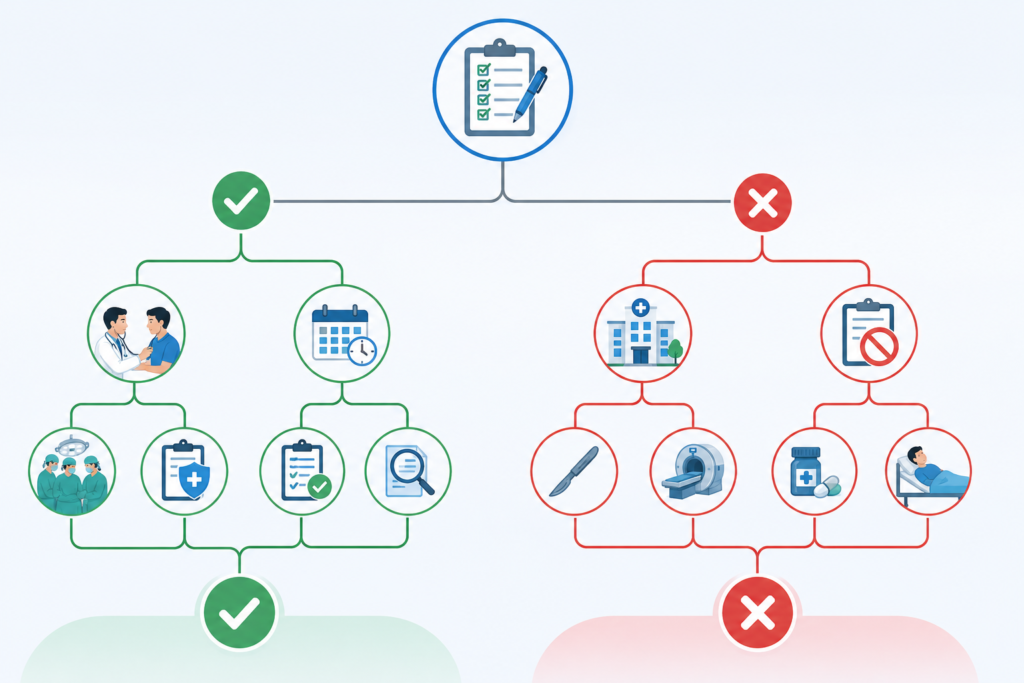
When a service pops up during recovery, run through these steps in order. It takes about ten seconds and saves you hours of rework.
- Is the service during an active global period? If no, bill it normally.
- Is it related to the original procedure? If yes, it’s bundled. No separate pay.
- Is it unrelated? Apply modifier 24 for an E/M visit, or modifier 79 for a procedure.
- Same-day minor procedure with a significant separate visit? Use modifier 25.
- Planned, staged, or a return to the OR? Reach for modifier 58, modifier 78, or modifier 79.
How to Use This Tree in Daily Billing
- Run it for every service that lands inside a global window.
- When in doubt, document the reason and check the payer policy.
- Train new billers to follow the same five steps every time.
How Do You Bill During the Global Period? (Modifier Quick Guide)
Modifiers are tiny two-character codes that tell the payer, “This service is different, and here’s why.” Use the right one and you get paid. Use the wrong one and you get a denial.
| Modifier | Use Case |
| Modifier 24 | Unrelated E/M during the post-op period |
| Modifier 25 | Significant, separate E/M on the same day as a minor procedure |
| Modifier 57 | Decision for major surgery |
| Modifier 58 | Staged or planned procedure during recovery |
| Modifier 78 | Unplanned related return to the OR |
| Modifier 79 | Unrelated procedure during the global period |
Modifier 24 vs Modifier 25 A Beginner-Friendly Comparison
These two get mixed up constantly, so let’s settle it.
Modifier 24 is for an unrelated visit during the post-op period. Think: a patient had shoulder surgery, then comes back weeks later with knee pain.
Modifier 25 is for a significant, separate visit on the same day as a minor procedure. Think: a patient comes in for a mole removal, but you also evaluate a brand-new, unrelated concern that day.
Different timing, different reason. They are not interchangeable, and they’re rarely used together.
How Do You Calculate When a Global Period Ends?
Getting the end date right keeps you from billing too early or too late. Here’s the step-by-step.
- Find the code’s global indicator (000, 010, or 090).
- Count the procedure date as day zero.
- Add the assigned days (0, 10, or 90).
- Confirm the end date before billing any related service.
Worked Examples
10-day global period: A procedure is done on March 1. Day zero is March 1. Add 10 days, and the period ends at midnight on March 11. Routine follow-up before then is bundled.
90-day global period: A total knee replacement happens on June 1. Add 90 days, and the global period runs through about August 30. Every routine post-op visit in that window is part of the bundle.
Red-Flag Mistakes That Trigger Global Period Denials

Most claim denials in this space come from a short list of repeat offenders. Spot them, fix them, move on.
- Wrong or missing modifier → Match the modifier to the exact scenario.
- Billing bundled services → Check the included vs excluded list first.
- Miscalculating the end date → Recount from day zero.
- Weak documentation → Record the reason and the diagnosis clearly.
- Ignoring payer rules → Verify the specific contract before you submit.
Documentation Examples That Protect Your Claims
Strong notes are your safety net. If a payer pushes back, clear documentation wins the appeal. Use this checklist on every global-period claim.
- Procedure date and CPT indicator logged
- Modifier rationale written in plain terms
- Unrelated diagnosis clearly noted for modifier 24
- Return-to-OR reason documented for modifier 78
Sample Documentation Language
Strong note: “Patient presents on 6/15 with new, unrelated right knee pain. Prior shoulder surgery on 6/1 (90-day global). E/M unrelated to surgical site. Modifier 24 applied.”
Weak note: “Follow-up visit, knee pain.” This gives the payer no reason to pay separately and almost guarantees a denial.
See the difference? The strong note explains the what and the why in seconds.
Real-World Billing Scenarios
Let’s put it all together with three common situations you’ll actually face.
Scenario 1 Unrelated Visit During Recovery (Modifier 24)
A patient had shoulder surgery (CPT 23472, a 90-day global period). Three weeks later, they return for new knee pain.
Correct billing: Bill the E/M visit separately with modifier 24, since the knee issue is unrelated to the surgery.
Scenario 2 Staged Procedure (Modifier 58)
A surgeon performs a skin graft, then plans a second graft two weeks later as part of the treatment plan.
Correct billing: Use modifier 58 for the second procedure, because it was planned in advance.
Scenario 3 Return to the OR for Complications (Modifier 78)
A patient develops a related complication after surgery and needs an unplanned return to the operating room.
Correct billing: Use modifier 78 to show a related, unplanned return to the OR during the post-op period.
Expert Insight Lessons From Years in Medical Billing

In my years working medical billing claims, the global period caused more avoidable denials than almost anything else. The pattern was always the same: the clinical care was fine, but the paperwork didn’t tell the story.
I once watched a clean 90-day claim get denied because the note simply read “post-op visit.” The visit was actually for an unrelated infection elsewhere in the body. We rewrote the documentation to spell out the unrelated diagnosis, attached modifier 24, and the appeal overturned the denial within weeks.
Here’s what I’d tell any new biller:
- Document the “why,” not just the “what.” A payer can’t read your mind.
- Run the decision tree every single time. Habits beat memory under pressure.
- Check the payer, then the code. Payer rules quietly decide more claims than people realize.
The teams that treat postoperative care tracking as a daily routine, not an afterthought, are the ones that get paid the first time.
Conclusion
The global period plays a crucial role in medical billing by defining which services are bundled into a surgical procedure’s reimbursement. Proper understanding of global periods helps healthcare providers avoid billing errors, reduce claim denials, and maintain compliance with payer guidelines. Accurate application of global period rules supports efficient revenue cycle management and smoother claims processing.
FAQs
What is the global period in medical billing?
The global period in medical billing is a set window of days when one bundled payment covers a surgery and its routine related care. It starts at the procedure and ends after a fixed number of days. Insurers won’t pay separately for normal follow-up during this time.
How long is the global period for surgery?
It depends on the procedure. Most codes carry a 0-day global period, a 10-day global period, or a 90-day global period. Minor procedures usually get 0 or 10 days, while major surgeries get 90 days.
Can you bill an office visit during the global period?
Yes, but only if the visit is unrelated to the surgery or qualifies as significant and separate. You apply modifier 24 for an unrelated post-op visit. Routine related follow-up stays bundled and isn’t billed separately.
Who is responsible for tracking the global period?
It’s a shared job. The front desk flags surgeries, the coder verifies the indicator and end date, and the biller applies the right modifiers. The practice manager audits denials and trains the team.
Does the global period include complications?
Often, yes. Complications that don’t require a return to the operating room are usually bundled. If the patient needs an unplanned related return to the OR, you use modifier 78 to bill it.
What is the difference between Modifier 24 and Modifier 25?
Modifier 24 is for an unrelated E/M visit during the post-op period. Modifier 25 is for a significant, separate E/M service on the same day as a minor procedure. Different timing, different purpose, and rarely used together.